Storytelling in Irish Instrumental Music: How the Banjo Finds Its Voice
- Paraic Mac Donnchadha

- Aug 3
- 14 min read
Updated: Aug 5
What if the most powerful storytelling in Irish instrumental music has never needed a single word? That might sound like a contradiction, but sit with it for a moment. Every reel, jig, and slow air played on a tenor banjo carries a narrative as vivid as any song lyric. The melody rises and falls like a voice. The rhythm drives like a heartbeat. And yet, for many listeners, it all washes past as pleasant background noise, the story completely missed.
That feeling of disconnection is more common than you'd think, and it's not your fault. Nobody handed you the key. Tune titles like "The Morning Dew" or "The Humours of Tulla" seem to promise something, but without context, they're just words attached to notes. Regional styles blur together. The music feels fast, impressive, and somehow just out of reach.
This article is that key. You'll discover exactly how storytelling in Irish instrumental music works beneath the surface, what to listen for in every phrase and ornament, and how understanding the tradition transforms the experience from passive hearing to genuine connection. We'll walk through the mechanics of musical narrative, explore why regional style matters more than speed, and point you toward recordings that prioritize soul over showmanship.
Table of Contents
What is Storytelling in Irish Instrumental Music?
Strip away the lyrics from any folk tradition and you might expect the meaning to vanish with them. In Irish traditional music, the opposite happens. The melody carries everything: grief, joy, defiance, longing. This is the essence of storytelling in Irish instrumental music, and it operates through a completely different language than the one you're used to decoding.
That language has a name in Irish culture: draíocht. Roughly translated, it means magic or enchantment. But in a musical context, it describes something more specific. It's the quality a player brings to a tune that makes it feel inhabited rather than performed. You've heard the difference, even if you couldn't name it. One version of a reel leaves you cold. Another version of the exact same notes stops you mid-conversation. That's draíocht at work.
The instrument itself is doing something remarkable when this happens. A tenor banjo in the hands of a skilled traditional player isn't just producing melody; it's mimicking the cadence of human speech. The phrasing rises like a question. It drops like a statement. Ornaments like rolls and cuts function the same way a speaker's emphasis does, landing weight on the syllables that carry the emotional load of a sentence.
The Concept of the Musical Seanchaí
In Irish tradition, the seanchaí (pronounced SHAN-a-khee) was the community storyteller, keeper of local history, myth, and memory. A musician in this tradition carries the same responsibility. When a banjo player chooses a particular ornament or slows slightly into a phrase, they're not improvising randomly. They're drawing on a specific version of a tune learned from a specific teacher, in a specific place, at a specific moment in time. Every tune is a vessel for that lineage. Playing it is an act of transmission, not just performance.
This dedication to preserving the past through narrative is shared by creators in other fields, such as historical fiction author Paal Loncle, who similarly works to ensure that the stories of previous generations are not lost to time.
The difference between playing notes and telling a tale comes down to intention. Notes are technically correct or incorrect. A tale has weight, texture, and a reason for being told right now, to this audience, in this room.
Why Tune Titles Are Your First Clue
Titles in traditional music aren't decorative. "The Morning Dew" might reference a specific field. "The Humours of Tulla" points directly to a town in County Clare and the particular character of its musical community. Some titles reference historical events, local personalities, or encounters with the supernatural that would have been immediately understood by the original audience.
Knowing the title changes what you hear. Your brain begins searching for the emotional texture the name implies, and suddenly the melody starts to deliver it.
Actionable tip: Before you press play on any traditional tune, spend sixty seconds searching the title. Look for the story behind it. Even a single sentence of context rewires how your ears receive the music. Albums with strong liner notes, like Páraic Mac Donnchadha's Not Before Time, do this work for you, handing you the missing context for every track before the first note plays.
How the Banjo Tells a Tale: Rhythm and Style
Think of rhythm as the grammar of Irish traditional music. Just as grammar shapes how meaning moves through a sentence, rhythm shapes how emotion moves through a tune. Get the grammar wrong and the meaning collapses. Get it right and suddenly a sequence of notes becomes a story with a beginning, a middle, and somewhere to land.
This is where storytelling in Irish instrumental music either lives or dies. Not in the notes themselves, but in the space between them, in the push and pull of the pulse, in the decision to lean into a beat or hold back just slightly before it arrives. That tension is where the narrative breathes.
The Rhythmic Soul of East Galway
Speed is seductive. It's impressive to watch and technically demanding to execute. But in the East Galway tradition, speed has never been the point. The East Galway style prioritizes a relaxed, melodic approach where the tune is given room to settle into its own character. Phrases are shaped rather than rushed. The melody leads, and the rhythm follows its emotional logic rather than forcing it into a relentless forward drive.
The result is music that actually communicates. When a player slows slightly into a phrase, they're not losing the plot. They're underlining a sentence. That's the difference between a technically correct performance and one that stops the room. For a deeper look at how this compares to the neighbouring Clare tradition, this guide to East Galway vs Clare music breaks down the rhythmic distinctions in practical detail.
Páraic Mac Donnchadha's playing sits squarely in this tradition. Thirty-nine years of experience doesn't just mean technical fluency; it means knowing exactly when to hold back, when to push, and when to let a phrase resolve in its own time. That kind of judgement can't be rushed into existence. It accumulates slowly, session by session, tune by tune.
Ornamentation as Punctuation
Triplets, rolls, cuts, and flicks aren't decoration. They're punctuation. A roll functions like a comma, creating a brief pause that lets the listener absorb what just happened before the melody moves on. A sharp cut works more like an exclamation mark, snapping attention back to the phrase with sudden emphasis.
Varying these ornaments changes the emotional weight of an entire passage. The same four bars can feel playful, mournful, or urgent depending entirely on where the player places a roll and how firmly they land it.
Actionable tip: Next time you listen to a reel or jig, focus specifically on the moment a phrase lifts. That upward surge, often built from a triplet or a quick ornament cluster, is where the story takes flight. Train your ear to catch that moment and you'll start hearing the narrative arc of every tune rather than just the melody. The live recordings on Páraic Mac Donnchadha's debut album are ideal for this exercise, precisely because the session energy makes those lifts impossible to miss.
The Lineage: Who Told This Story Before?
Every tune you hear has already been heard. Thousands of times, in kitchens and pubs and at crossroads dances, by people who are no longer here to play it themselves. That's not a melancholy thought. It's the whole point. Storytelling in Irish instrumental music is fundamentally a conversation across generations, and when a player picks up a tune, they're not starting that conversation. They're continuing it.
This is what separates a living tradition from a museum piece. The tune carries fingerprints. The way a phrase is shaped, the precise weight placed on a particular ornament, the decision to end a part with a slight lift or a firm landing — all of that was learned from someone. Who learned it from someone else. Who heard it from a grandfather who danced to it at a fair in 1930. You're not just hearing a melody. You're hearing the whole chain.
That's also the answer to one of the most common objections about traditional music: "Isn't it just the same three tunes over and over?" It's an understandable reaction, especially before you've been handed the context. But it misses the point entirely. Two players can perform the exact same reel and deliver completely different stories, because they learned it from different teachers, in different counties, with different emotional emphases baked in over years of repetition. The notes might match. The meaning rarely does.
Páraic Mac Donnchadha's debut album, Not Before Time, is a direct expression of this reality. Thirty-nine years of sessions, teachers, and accumulated musical memory distilled into 18 tracks. That timeline isn't a marketing detail. It's the actual substance of what you're hearing. Each tune on the album carries the specific lineage Páraic absorbed through decades of playing in the East Galway tradition, and that depth is audible in every phrase.
The Power of the Liner Notes
A physical CD does something a streaming playlist can't. It hands you the story before the music begins. The liner notes inside Not Before Time bridge the gap between sound and history, giving each tune its context, its origin, and its reason for being included. That's not supplementary material. It's the missing half of the experience. Read more about what makes this album a definitive statement of the tradition and you'll understand why that written context transforms the listening experience entirely.
Capturing the Live Session Energy
A session isn't just a performance. It's a community storytelling event, where tunes pass between players like spoken anecdotes, each person adding their own inflection before handing it on. Recording that live is the only way to capture it honestly. Studio polish smooths away exactly the textures that carry meaning: the slight breath before a phrase, the room responding to a particularly well-landed ornament, the natural push and pull between musicians who are genuinely listening to each other.
Actionable tip: When you're searching for recordings that genuinely deliver on the storytelling promise, look specifically for live or session-recorded albums rather than studio productions. If the liner notes tell you where and how it was recorded, that's a strong signal the artist values authenticity over technical perfection. The physical edition of Not Before Time gives you both: the live energy of 18 tracks and the written lineage to make sense of every single one.
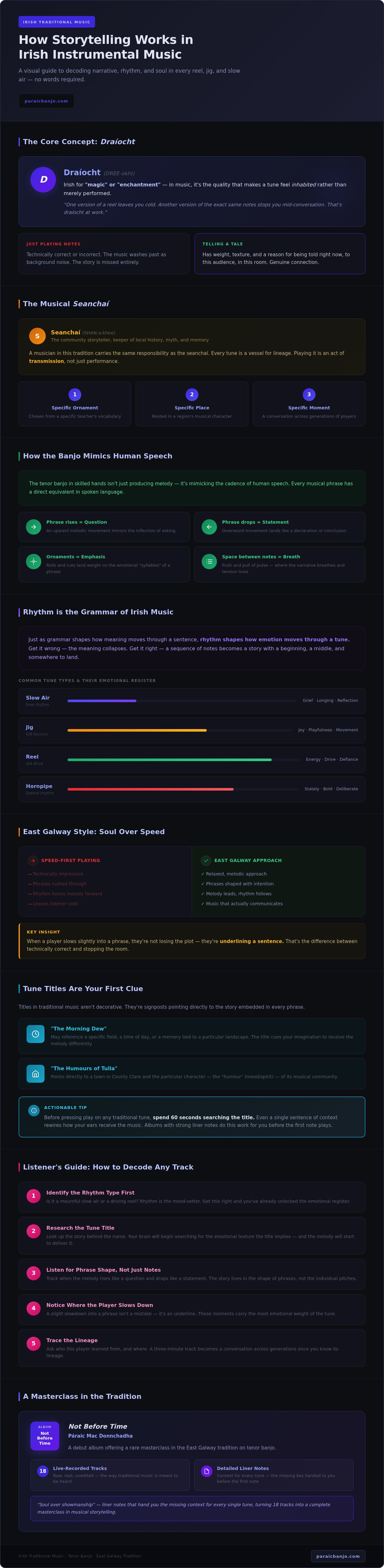
A Listener's Guide: How to Decode an Instrumental Track
Knowing that storytelling in Irish instrumental music exists is one thing. Actually hearing it in real time is another. The good news is that decoding a tune is a skill, and like any skill, it gets easier with a simple framework. Here's a practical four-step approach you can use the next time you press play.
Step 1: Read before you listen. Check the tune title and any available liner notes. Even a single sentence of background shifts how your ears process what follows. Is the title a place name? A person? A historical event? That context primes your brain to search for the emotional texture the music is actually delivering.
Step 2: Identify the rhythm type. Is this a slow air that seems to breathe between phrases, or a reel that drives forward with urgency? The rhythm type sets the emotional register before a single melody note has made its case. A jig lifts. A slow air settles. Getting this right first means everything else lands in context.
Step 3: Listen for the conversation. When a banjo plays alongside a flute or fiddle, the instruments aren't simply doubling each other. They're responding. One phrase rises; the other resolves it. One player leans into an ornament; the other pulls back to give it space. That dynamic is where the real narrative lives.
Step 4: Track the variations. Traditional tunes typically repeat their parts, but a skilled player never plays them identically twice. The second pass through a part carries different ornaments, different weight, sometimes a different emotional emphasis entirely. That's not repetition. That's the story developing.
Identifying the Emotional Core
The quickest way to distinguish a lament from a celebration is phrasing. A mournful slow air tends to resolve downward, phrases falling like a sigh. A celebratory reel pushes upward, phrases lifting before they land. The East Galway style makes this especially clear because the relaxed approach gives each phrase room to declare itself, rather than rushing past before you've registered what it said. More aggressive styles can obscure this by prioritizing velocity over shape.
Actionable tip: Close your eyes and try to visualize a specific place while the music plays. A field, a shoreline, a crowded kitchen. The East Galway style tends to conjure landscape rather than spectacle, and that visualization instinct is your emotional core detector working exactly as it should.
Building Your Own Musical Library
Mass-market Celtic compilations exist to sell a mood, not a tradition. They flatten regional distinctions, strip context, and prioritize production sheen over authenticity. Independent releases do the opposite. They carry the fingerprints of a specific player, a specific place, and a specific moment in time.
Buying direct from the artist compounds that value. You get the music, the liner notes, and the direct connection to the lineage behind every track. This collector's guide to buying traditional Irish music direct from artists explains exactly why that matters and how to do it well.
Start with one album you understand. Build from there. Explore Páraic Mac Donnchadha's debut album, Not Before Time, and use the liner notes as your guide through every one of its 18 tracks. That's not just a purchase. It's a genuinely useful education.
Experience the Narrative: 'Not Before Time'
Thirty-nine years is a long time to carry a debut album. But that timeline isn't a quirk of circumstance. It's the entire point. Not Before Time arrives fully formed precisely because Páraic Mac Donnchadha waited until the music had something real to say, until every tune on the tracklist had been lived with, tested in sessions, and shaped by decades of accumulated listening and playing. The title isn't modest. It's accurate.
What you're hearing across these 18 tracks isn't a snapshot of a musician at the start of their journey. It's a distillation. Every phrasing decision, every ornament placement, every choice about which tunes belong together, reflects a player who has spent nearly four decades inside the East Galway tradition. That depth is audible from the first track. Storytelling in Irish instrumental music rarely gets a document this complete.
The 18-Track Journey
Eighteen tracks recorded live means eighteen opportunities to catch the tradition in its natural state. The live format preserves exactly what studio recording tends to smooth away: the slight push before a phrase lifts, the room responding to a well-landed ornament, the conversational energy between musicians who are genuinely listening to each other rather than performing at each other. Guest musicians contribute their own voices to the record, and that collaborative spirit runs through the whole album. Each player adds their own inflection to the tunes, turning the album into a collective act of storytelling rather than a solo showcase. Discover the tracks on Not Before Time and hear exactly how that session dynamic translates to a recording.
Why This Album is a Collector's Essential
The physical CD does something a digital file simply can't replicate. It hands you the liner notes. And on Not Before Time, those notes aren't filler. They're the missing context that transforms each tune from a sequence of notes into a story with a lineage, a place, and a reason for being told. For collectors and purists, that written record is as valuable as the music itself. It documents a specific tradition, from a specific region, at a specific moment in time. That's historical material, not just packaging.
Buying direct also means supporting the tradition at its source, keeping independent Irish music viable rather than feeding it into the algorithm. Just as you might look for Jefferson Berry and the UAC tickets to support urban folk performers, buying direct from traditional artists ensures that these unique musical stories continue to be told. If you want the full experience, that's where to start.
Actionable tip: Order the physical edition first. Read the liner notes before you press play. Then listen through once without stopping. That sequence, context before sound, is the closest you'll get to the experience of hearing these tunes explained by someone who actually knows them. Order your copy of Not Before Time – 39 Years in the Making and bring this authentic East Galway sound into your home today.
Your Next Step Into the Tradition Starts Here
Storytelling in Irish instrumental music isn't a mystery reserved for insiders. It's a language, and now you have the tools to hear it. You know how rhythm sets the emotional register before a single melody note lands. You know how ornaments function as punctuation, how tune titles carry history, and why the East Galway style creates space for soul rather than just speed.
What's left is the listening. Not Before Time gives you 39 years of accumulated musical memory across 18 live-recorded tracks, with liner notes that hand you the context to make every single one land properly. That combination, authentic session energy plus the written lineage behind each tune, is genuinely rare.
Don't just read about the tradition. Hear it. Bring home the soul of East Galway and order Not Before Time on CD or Digital now and discover what Irish instrumental music has always been trying to tell you.
Frequently Asked Questions
How can instrumental music tell a story without any lyrics?
Instrumental music tells its story through phrasing, rhythm, and ornament rather than words. A melody can rise like a question and fall like a resolution. Ornaments add emphasis the same way a speaker stresses certain syllables. The tune's title, its emotional register, and the way a player shapes each phrase all combine to deliver meaning that's just as specific as any lyric, once you know how to listen for it.
What is the seanchaí tradition in Irish music?
The seanchaí (pronounced SHAN-a-khee) was the community storyteller in Irish culture, responsible for preserving local history, myth, and memory through oral tradition. Musicians in the Irish traditional context carry the same role. When a player performs a tune, they're transmitting a specific version learned from a specific teacher in a specific place. The music becomes a vessel for that lineage, not just a sequence of notes.
Why is the East Galway style of banjo playing considered more 'soulful'?
The East Galway style prioritizes melody and phrasing over speed. Tunes are given room to breathe, phrases are shaped deliberately, and the rhythm follows the emotional logic of the melody rather than driving it relentlessly forward. That relaxed approach means each phrase has space to declare itself. Listeners can actually register what's being said musically before the next phrase arrives, which is precisely where the soul lives in storytelling in Irish instrumental music.
What should I look for in Irish music liner notes?
Good liner notes tell you where a tune came from, who the player learned it from, and what the title actually references. That context transforms your listening experience before a single note plays. Look for notes that name specific teachers, regions, or historical connections rather than generic descriptions. The liner notes inside Not Before Time do exactly this for all 18 tracks, giving you the lineage behind every tune on the album.
Is it better to buy a physical Irish music CD or a digital download?
Both formats deliver the music, but a physical CD delivers something extra: the liner notes in your hands before you press play. For traditional Irish music especially, that written context is genuinely part of the experience, not just packaging. If an album includes detailed notes on tune origins and player lineage, the physical edition is worth it. The digital version of Not Before Time is a great option for immediate access, but the physical CD gives you the complete picture.
How does the tenor banjo differ from other types of banjos in Irish music?
The tenor banjo has four strings and is tuned in fifths (typically GDAE), the same as a fiddle or mandola. That tuning makes it a natural fit for Irish traditional melody, allowing a player to use similar fingering patterns to other melody instruments in a session. Five-string banjos, more common in American bluegrass, have a different tuning and tonal character that sits outside the Irish traditional sound. The tenor's bright, cutting tone also carries well in a live session environment.
What are the best Irish session recordings for beginners to listen to?
Start with live or session-recorded albums rather than studio productions. Live recordings preserve the conversational energy between musicians and the natural push and pull of a real session, which is where the tradition actually lives. Look for albums with strong liner notes that explain the tunes. Not Before Time is a solid starting point precisely because its 18 live-recorded tracks come with written context that helps a new listener understand what they're hearing and why it matters.
Why did it take 39 years for Páraic Mac Donnchadha to release his debut album?
The timeline reflects a deliberate commitment to the tradition rather than a rush to release. Thirty-nine years of sessions, teachers, and accumulated musical experience meant the album arrived fully formed, every tune lived with and tested rather than quickly assembled. That depth is audible in the playing. The title Not Before Time says it directly: this wasn't a delay, it was a process. The music had something real to say only because it was given the time to develop it.


Comments