The Essence of Irish Music: Understanding the Pulse of the Tradition in 2026

Have you ever sat in a crowded pub, listening to a fiddle and a banjo trade tunes, and felt like there was a secret language being spoken that you just couldn't quite translate? It's a common frustration for many who love the sound but feel like an outsider looking in, especially when faced with over-produced "Celtic" pop that lacks the real grit of a session. You're likely searching for the essence of irish music, that intangible "soul" or "pulse" that makes a reel feel like it's breathing.
In 2026, finding that authentic spark is harder than ever amidst a sea of digital noise. In this guide, we'll peel back the layers of technical jargon to reveal how a master banjo player hears the tradition. We'll explore the steady "swing" of East Galway and the driving "lift" of Clare styles, helping you identify high-quality recordings like the 18 tracks on Not Before Time that capture raw, live energy. By the time we're done, you'll know exactly how to listen like a purist and feel a bone-deep connection to this living heritage.
Table of Contents
What is the Essence of Irish Music? Defining the 'Pulse'
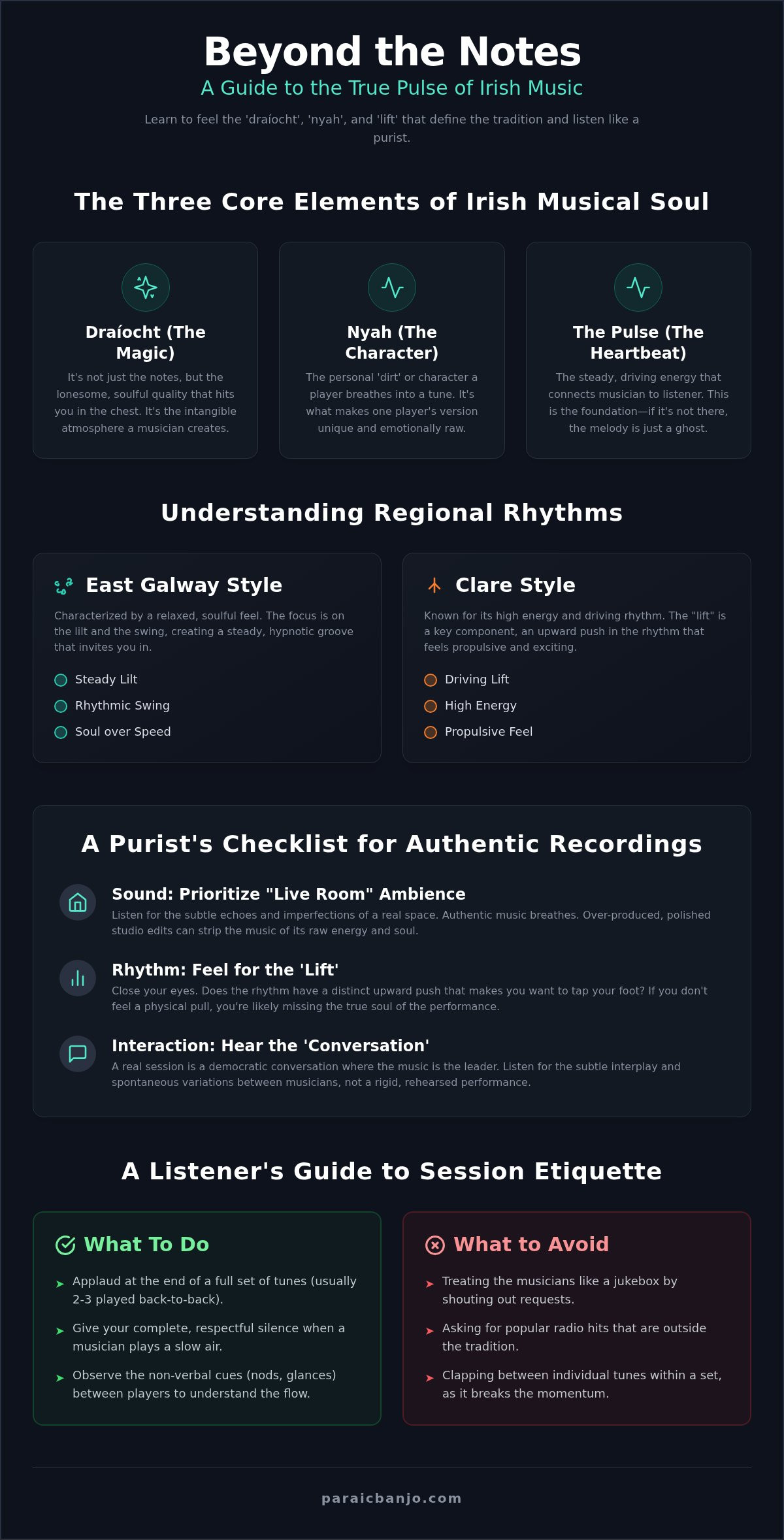
The essence of irish music isn't something you'll find captured in a dusty textbook or trapped within the rigid lines of a musical score. It's a living, breathing thing. While Irish traditional music is famously built on ancient melodies, the real magic happens in the space between the notes. We call this the 'pulse'. It's the difference between a clinical, mechanical performance and a tune that makes the hair on your arms stand up. Unlike classical music, which often relies on strict adherence to a conductor's baton, our tradition thrives on a rhythmic freedom that feels both ancient and immediate.
The Concept of Draíocht and the Nyah
Draíocht is the Irish word for magic, but for a musician, it's that lonesome, soulful quality that hits you right in the chest. Then there's the 'nyah'. That's the personal character or "dirt" a player breathes into a note. You could have two musicians playing the exact same set of reels. One might hit every note with technical perfection but leave the room cold. The other, perhaps playing with a more relaxed hand, has that 'nyah' that draws everyone into the circle. This isn't something you can buy or learn in a formal conservatory. It's passed down through generations, absorbed in the corners of crowded pubs and quiet kitchens. Understanding the essence of irish music means learning to feel rather than just hear.
Why Rhythm is the Heartbeat of the Tradition
Don't confuse speed with energy. In the East Galway style, we often value the lilt and the swing over the breakneck pace you might hear in over-produced stage shows. The rhythm has to drive the dance, even if there isn't a single person on the floor. If the rhythm isn't there, the melody is just a ghost. The pulse is the steady, driving energy that connects the musician to the listener. It's the heartbeat that keeps the tradition alive. This focus on the "soul" of the rhythm is exactly why I waited to record my debut album, Not Before Time – 39 Years in the Making, until the feeling was exactly right.
Actionable Tip: Next time you're listening to a traditional recording, try to find the 'lift'. This is that specific moment where the rhythm feels like it's pushing upward, making you want to tap your foot or nod your head without even thinking about it. If you don't feel that physical pull, you're likely listening to something that's missing the true soul of the music. You can experience this authentic energy yourself by exploring the individual digital tracks from my latest collection, where the focus is entirely on that rhythmic lift.
The Unspoken Language of the Irish Session
Think of an Irish session as a deep, spirited conversation between old friends. It isn't a stage show designed for an audience, nor is it a rigid recital. In a real pub circle, the music itself acts as the leader. This democratic spirit is where the essence of irish music truly thrives. Everyone follows the tune, contributing their own voice while respecting the collective path. When a group of musicians clicks, you get "the lift." It's a sudden surge in energy that feels like the music is carrying everyone along. You can experience this energy yourself in the tracks of Not Before Time – 39 Years in the Making, where we recorded live to keep that authentic session spark alive.
Session Etiquette for the Listener
Being a good listener is an art form. It's about respecting the circle and the flow of the evening. Traditional sessions aren't about requests, so don't treat the musicians like a jukebox. Asking for a popular radio hit might get you a polite smile, but it breaks the natural momentum of the tunes. Watch the players closely. You'll see a nod of the head, a lifted eyebrow, or a specific tilt of an instrument. These are the visual cues we use to signal a change in tune or the end of a set.
Actionable Tip: Know when to engage. It's customary to clap at the end of a full set of tunes, not between every individual reel or jig. If someone starts a slow air, give them your full silence. That quiet respect is just as much a part of the session as the loud, driving sets.
The Role of Improvisation and Variation
No two sets are ever identical. A reel might be played four times through, but each round features subtle shifts in ornamentation. We use rolls, triplets, and cuts to keep the melody moving. These aren't just technical flourishes; they add to the "essence" by reflecting the player’s mood in that specific moment. If you want to dive deeper into the structures we use, check out Reels and Jigs: The Heartbeat of Irish Sessions. It's these tiny, spontaneous variations that make every performance a unique moment in time. This constant evolution ensures the tradition stays fresh, even when we're playing tunes that are hundreds of years old. Every note is a chance to add something personal to the storied history of the craft.
Regional Styles: The Heartbeat of East Galway and Clare
If you travel through the West of Ireland, you'll notice the landscape changes from the rugged limestone of the Burren to the soft, rolling fields of East Galway. The music does the exact same thing. Regional styles are the fingerprints of our tradition, and understanding them is key to grasping the essence of irish music. While some areas are known for a blistering, athletic pace, the East Galway tradition is famously soulful. It prioritizes "the lilt"—a rhythmic, melodic bounce—over raw speed. It’s a style that invites you to lean in and listen, rather than just letting the sound wash over you. You can dive deeper into these nuances in our guide on East Galway vs Clare Music.
The geography of the West played a huge role in shaping these sounds. Before the internet or easy travel, musicians were influenced by the quiet, often lonesome atmosphere of their local townlands. This isolation birthed a specific "lonesome" quality in the banjo and fiddle playing of the region. It’s a sound that carries the weight of history but stays firmly rooted in the joy of the present moment.
The Rhythmic Mastery of the East Galway Style
In East Galway, we like to let the melody breathe. We use a relaxed tempo that gives every note its own space to shine. This isn’t about being slow; it’s about being steady. The tenor banjo is the perfect vehicle for this because it’s both a melodic and a percussive instrument. When played with a relaxed hand, the banjo can highlight the subtle "swing" that makes a reel feel alive. It’s a rhythmic mastery that took me decades to truly settle into, a journey I finally documented across the 18 tracks of my debut album.
Actionable Tip: To truly hear the East Galway style, don't just focus on the notes. Listen for the space between them. That tiny, microscopic silence is where the "swing" lives. If the music feels like it’s gently rocking rather than sprinting, you’ve found the heart of the Galway sound.
Clare’s Influence: Flow and Soul
Just across the border, the Clare style brings a different kind of energy. It’s often described as "steady" and "rolling," with a relentless, driving lift that’s impossible to ignore. These two regions have constantly overlapped and influenced each other over the years. My own playing is a bridge between these worlds, rooted in the soulful lilt of Galway but infused with the steady flow of the Clare tradition. This blend of regional identities is what gives the music its depth. It isn't just about where you’re from; it’s about the layers of tradition you carry with you. If you're looking to bring this authentic sound into your own home, you can find my Physical CD or Digital Album, which serves as a definitive statement of these regional styles.
How to Listen Like a Purist: A Practical Checklist
If you're tired of over-produced soundtracks that sound more like a movie trailer than a Tuesday night in County Clare, it's time to refine your ear. Truly capturing the essence of irish music requires a bit of detective work. You have to look past the glossy covers and cinematic arrangements to find the raw, honest heart of the tradition. A purist doesn't just listen to the melody. They listen for the grit, the breath, and the environment where the music was born. Finding these authentic gems is the best way to move from being a casual observer to a true part of the tradition.
Actionable Tip: Avoid albums that lean heavily on synthesizers, "cinematic" orchestral backings, or programmed drum beats. These layers often mask the natural rhythm and "lift" of the instruments, stripping away the very soul you're trying to find. Stick to recordings where the acoustic instruments are the undisputed stars of the show.
What to Look for in a Recording
When you're browsing for new music, start by identifying the "room sound." This is the natural reverb you hear when a musician plays in a real space rather than a sterile, soundproofed booth. It gives the music a sense of place. Look for tracks that are unaccompanied or only lightly accompanied by a guitar or bouzouki. This allows the banjo or fiddle’s true voice to come through without being crowded. Finally, check if the tracks are organized into "sets." In a real session, we never play just one tune. We string three or four together to build momentum. A recording that features these sets is much more likely to capture the genuine energy of a live performance.
The Importance of Liner Notes
Never skip the liner notes. For a traditional musician, the "story" of a tune is just as important as the notes themselves. Knowing that a specific reel was learned from an old neighbor in East Galway adds a layer of emotional weight that you can't get from a digital file name alone. Liner notes are the map that connects a modern listener to the 19th-century origins of a reel. They reveal the musician’s lineage and the history of the tunes, transforming a simple listening experience into a historical journey.
I took great care to include these stories in my own work. You can read about the history behind each of my selections in Inside the Liner Notes: 18 Tracks of Pure Banjo. If you're ready to hear how these elements come together in a live-in-studio setting, buy the full Not Before Time album and experience the tradition exactly as it was meant to be heard.
Preserving the Soul: Why 'Not Before Time' Matters
Capturing the essence of irish music isn't a task for the rushed. It requires a deep, lived-in understanding of the tradition that only comes with decades of sitting in the corner of a session. My debut album, Not Before Time – 39 Years in the Making, isn't just a collection of tunes. It's a definitive statement of a lifetime spent chasing that elusive 'pulse'. By choosing to record live in a room with other masters, we managed to bottle the raw energy of a real session. This approach ensures the music feels alive, vibrating with the same spirit you'd find in a small pub in East Galway or Clare.
The 18 tracks on the album serve as a rhythmic masterclass. We didn't aim for studio perfection that strips away the character of the instruments. Instead, we focused on the "nyah"—that soulful, personal quality that makes the music feel human. You can bring the essence of the Irish session into your home with the physical CD or digital download and hear exactly how that 39-year journey sounds in every note.
39 Years in the Making: A Lifetime of Pulse
People often ask why I waited nearly four decades to release my first album. The answer is simple. The style needs time to settle. It needs to age and mature until the rhythm becomes second nature. Critics have praised the soulful and rhythmic style of the tracks, noting how the banjo's lilt drives the melody forward without ever feeling forced. I didn't want this to be a solitary effort. By collaborating with other traditional masters, the project became a true conversation. It reflects the democratic spirit of the session where everyone contributes to the collective "lift" of the set.
The Collector's Choice: Physical vs. Digital
Deciding between a physical CD and a digital album often comes down to how deep you want to dive into the history. The physical CD is a favorite for collectors because of the detailed liner notes. These notes provide the "map" we talked about earlier, connecting you to the 19th-century origins of the reels and the lineage of the musicians who played them. If you're curious about the lasting appeal of the disc, read more about Why Collectors Still Prefer the Physical CD Format.
Actionable Tip: If you choose to buy digital tracks, ensure you're downloading high-quality audio files. Standard compressed files can sometimes muffle the natural resonance and "ring" of the banjo strings. High-fidelity files allow you to hear the subtle textures of the room sound, making the listening experience feel much more authentic. Whether you choose the disc or the digital tracks, the goal is to feel that heartbeat of the tradition in your own space. Enjoy the journey through these 18 tracks. It’s been a long time coming!
Let the Music Lead You Home
We've explored the quiet kitchens of East Galway and the driving energy of Clare, discovering how that intangible "pulse" truly defines the essence of irish music. You now have the practical tools to identify authentic recordings by seeking out the raw room sound and the deep history found in musician lineage. It's about more than just hearing a melody; it's about feeling the lift of the tradition in your own bones.
If you're ready to bring that authentic session energy into your living room, my debut album is finally here. It features 18 tracks of live, rhythmic mastery recorded with fellow masters, backed by 39 years of development. Every physical copy includes extensive liner notes to serve as your map through the tunes and the history of the craft.
Keep your ears open and your feet tapping. The tradition is a living conversation, and I'm thrilled to invite you into the circle. See you at the next session!
Frequently Asked Questions
What is the difference between Irish folk music and traditional Irish music?
Traditional Irish music centers on instrumental dance forms like reels and jigs. It relies on aural transmission and specific regional ornamentation. Irish folk is a wider category that often includes ballads, protest songs, and modern lyrics. While they overlap, traditional purists focus on the "pulse" and the "nyah" of the instrument rather than vocal narratives. This distinction ensures the rhythmic soul of the dance remains the primary focus.
Is the tenor banjo a traditional Irish instrument?
The tenor banjo became a core part of the tradition in the early 1900s. While it arrived later than the uilleann pipes, it's now a vital voice for expressing the rhythmic "swing" of the music. Its percussive nature makes it ideal for the East Galway style, where the lilt and the steady pulse are prioritized over raw speed. It has earned its place through decades of session play.
How can I tell if an Irish music recording is 'authentic'?
Authentic recordings usually feature a "live" feel with natural room reverb. You should look for "unaccompanied" or "lightly accompanied" tracks where the instruments aren't buried under synthesizers. Check the credits for a "live-in-studio" approach. This preserves the raw energy and the subtle textures of the performance. My debut album was recorded this way to ensure the 18 tracks kept their original session spark and rhythmic honesty.
What does 'the lift' mean in Irish music?
"The lift" is the buoyant, rhythmic energy that makes a tune feel like it's taking flight. It isn't about playing faster; it's about the collective "swing" created when musicians click. This phenomenon is central to the essence of irish music, transforming a simple melody into a living, breathing experience that compels you to tap your foot. It is the intangible magic that every session player strives to achieve.
Why do Irish musicians play several tunes in a row?
We play "sets" of several tunes in a row to build momentum and create a narrative flow. Transitioning from one reel to another keeps the energy high and allows musicians to explore different melodic "conversations." This practice mirrors the needs of traditional dancers, who require a steady, uninterrupted pulse to maintain their movement throughout a full set of dances. It turns a single tune into a spirited journey.
Can I learn to appreciate Irish music if I don't play an instrument?
You don't need to be a musician to feel the soul of the tradition. Active listening involves spotting the "nyah" or the specific "lift" in a player's style. Reading detailed liner notes can also help you understand the historical context and the lineage of the tunes. This knowledge deepens your emotional connection to the music, making the experience much more rewarding for any dedicated listener or collector.
What is an Irish music session like?
An Irish session is an informal gathering where musicians play for the sheer joy of the tunes. It's a democratic circle where the music, not a single person, acts as the leader. Unlike a concert, it's a conversational exchange between friends. Listeners are welcome, but the focus remains on the collective energy and the unspoken communication between the players who have gathered in the corner of the pub.
Where can I buy traditional Irish music that supports the artist directly?
The best way to support the tradition is by purchasing directly from the artist's storefront. You can find my work, including the physical CD and digital tracks, at the official Páraic Banjo website. Buying directly ensures you get high-quality audio files and the full historical context provided in the liner notes. This direct connection helps independent musicians continue their long-term projects while providing you with the most authentic listening experience.


Comments