The Pulse of the West: A Guide to the Traditional Music of County Clare

Updated: Sep 3
Have you ever spent hours practicing a reel only to find it sounds more like a typewriter than a living, breathing dance? It's a common frustration for many players who feel their music is flat or mechanical. The secret to fixing that stiff sound lies in the traditional music of county clare, a style defined by its infectious, percussive pulse. You aren't alone if you're confused by regional differences or struggling to find recordings that capture the raw energy of a real session. Most digital tracks feel too clinical, losing the grit and soul that makes our tradition special.
In this guide, you'll finally unlock the mystery of the "Clare lift" and learn how to move beyond just playing notes to playing the rhythm. We're going to explore the legendary players and instruments that have shaped this sound over decades. I'll show you how to identify authentic recordings, such as my debut album, Not Before Time: 39 Years in the Making, so you can study the rhythmic mastery that defines our heritage. It's about the heartbeat. The swing. That unmistakable drive. Let's get started on your journey to the musical heart of the west.
Table of Contents
Why County Clare is the Heartbeat of Irish Traditional Music
If you've ever stepped into a quiet pub in Ennis or Doolin and felt the floorboards start to hum, you've encountered the soul of the West. It isn't just sound; it's a physical presence. The traditional music of county clare is world-famous not because players here are necessarily faster than everyone else, but because they possess a specific rhythmic drive we call the "lift." While some regions focus on flashy technicality, Clare music is all about the pulse. It's a soulful, percussive style that feels like a deep conversation between the musicians and the dancers.
This unique sound didn't happen by accident. For generations, the rugged landscape of the West provided a kind of geographical isolation. This allowed local styles to marinate and mature without being watered down by outside influences. Because of this strong history of Traditional music, the county became a sanctuary for the old ways of playing. It's why we consider it the "home" of the music. The melodies here aren't just played; they're felt.
The Living Session Culture
In Clare, the music isn't trapped in a museum. It lives in the "seisiún" (pronounced seh-shoon), the informal gathering of musicians in a local pub. This is where the real learning happens. We don't use sheet music here. Tunes are passed down by ear, from one generation to the next. The "pulse" of a session is more important than the venue itself. If you're visiting, try sitting near the musicians and watching how they tap their feet. It's the best way to internalize the rhythm. You can even grab a copy of my album Not Before Time - 39 Years in the Making to hear how that live session energy translates to a recording.
A Brief History of the Clare Sound
The modern scene owes a huge debt to the house dances of the past. Before pubs became the main stage, music was played in kitchens for dancers. This meant the rhythm had to be rock solid. Legends like Micho Russell helped carry this spirit into the modern era, showing us that a simple tune played with the right feeling is worth more than a thousand notes played without soul. Events like the Willie Clancy Summer School in Miltown Malbay, running from July 3rd to July 12th, 2026, continue to draw people from across the globe to study the traditional music of county clare. These gatherings ensure the "lift" remains as vibrant today as it was a century ago. To dive deeper into these rhythms, check out our individual digital tracks and see which ones speak to your own musical spirit.
Understanding the 'Clare Lift': The Secret of Rhythmic Mastery
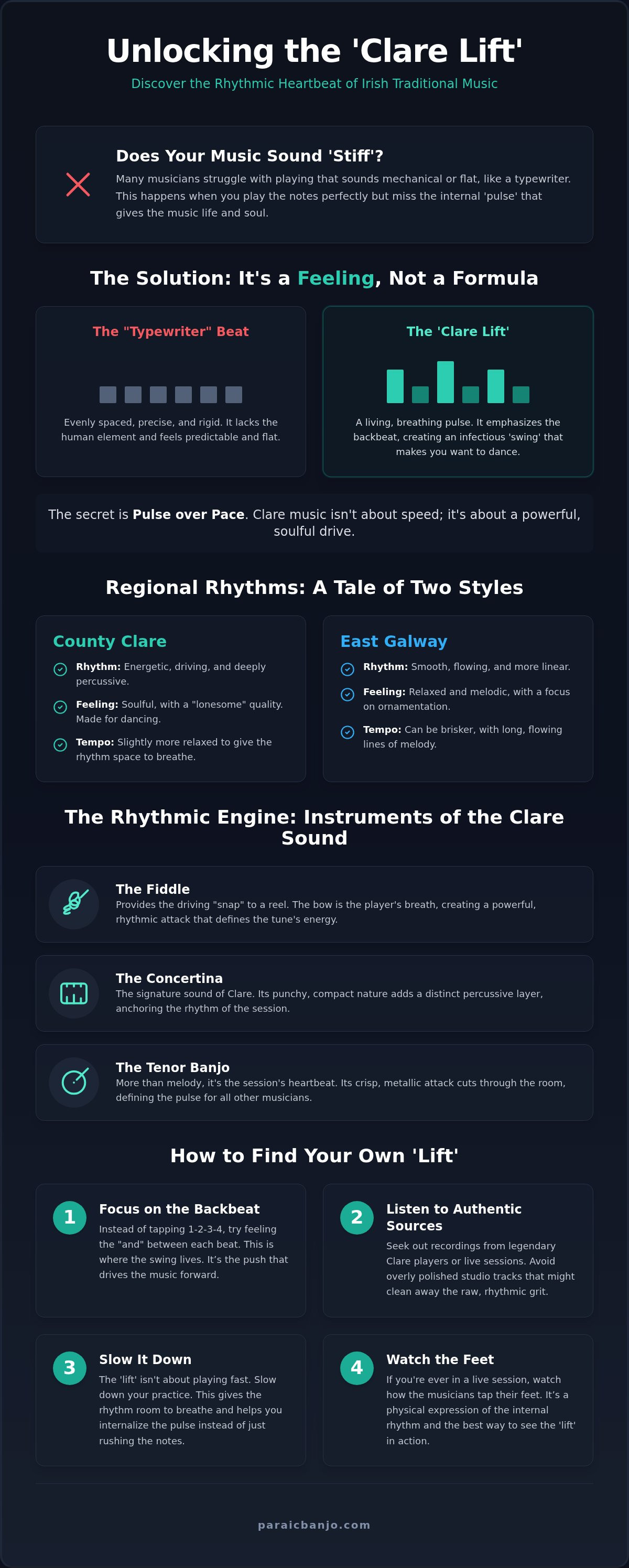
The "lift" isn't something you can measure with a stopwatch. It's a feeling. When people talk about the traditional music of county clare, they're describing a specific kind of rhythmic bounce that makes it impossible to keep your feet still. Unlike a mechanical metronome that hits every beat with the same cold precision, the Clare style breathes. It relies on a strong backbeat, an internal pulse that emphasizes the "off" beats. This creates a swinging sensation that drives the music forward without needing to increase the tempo. It's the difference between a march and a dance.
Beyond the rhythm, there's a "lonesome" quality to the tunes here. It's a soulful depth that suggests the music has seen a lot of history. To achieve this, the most important tool isn't your left-hand fingering; it's your right hand or your breath. That's where the expression lives. Whether it's the snap of a bow or the push of a bellows, the rhythm is generated by the physical movement of the player. A great resource by Niall Keegan examines the various musical styles across the county, showing how these subtle shifts in technique define the traditional music of county clare.
The Rhythmic Engine: Fiddle and Concertina
The concertina is arguably the signature sound of Clare. Its compact, punchy nature fits the rhythmic style perfectly. While the fiddle provides a driving "snap" to a reel, the concertina adds a percussive layer that anchors the session. You'll notice that Clare musicians often play at a slightly more relaxed tempo compared to players from Sligo or Donegal. We don't rush. By slowing down just a hair, we give the rhythm space to expand, allowing that famous "lift" to really take hold.
The Banjo as a Percussive Instrument
Don't think of the tenor banjo as just a melody instrument. In a Clare session, it's the heartbeat. It provides a crisp, metallic attack that cuts through the room, defining the pulse for everyone else. The secret to this driving rhythm is a completely relaxed wrist. If you're tense, the music sounds mechanical. If you're loose, it flows. I spent decades honing this specific "pulse" for my debut album, and you can hear that authentic, live energy on every track of Not Before Time: 39 Years in the Making. It's about capturing the soul of the room, not just the notes on a page.
Regional Rhythms: Comparing Clare and East Galway Styles
The boundary between Clare and Galway is more than just a line on a map; it's a meeting point for two of the most influential styles in Irish history. While the traditional music of county clare is famous for its percussive "lift," its neighbor to the East offers a different kind of magic. For decades, musicians have traveled across these borders, swapping tunes and techniques. This cross-pollination has created a rich, layered sound that defines the West of Ireland. Understanding how these two styles interact is the key to moving beyond a mechanical playing style and finding your own musical voice.
If you're curious about how these regional nuances evolved, my detailed breakdown of East Galway vs Clare Music: A Guide to the Rhythmic Soul of the West offers a deeper look into the history of these neighboring traditions. Many players find that blending the two styles creates a more complete, versatile sound that works in any session.
The Lonesome Sound of East Galway
East Galway music is often described as "lonesome." This doesn't mean it's sad; rather, it possesses a deep, melodic soul that feels intimate and reflective. The tempo is generally more relaxed, which allows players to focus on intricate ornamentation. One hallmark of this style is the "ghost stroke." These are quiet, flicked notes on a banjo or fiddle that you feel more than you hear, adding a shimmering texture to the melody. If you want to capture this feel, try slowing your favorite reel down to 80% speed. Focus on the space between the notes. This focus on the subtle details that convey profound meaning is a principle shared by fine art sculptor Richard Macdonald, whose work explores the full range of human emotion through the delicate balance of form and space. This style is perfect for those late-night, quiet sessions where the music is about connection rather than volume.
In contrast, Clare music is built for the dance floor. It has an infectious drive that feels like it's physically pulling the listener into the rhythm. This is largely due to the close relationship between the music and traditional set dancing. Every note is designed to support the dancer's step. To spot the "Clare snap," listen for a sharp, emphasized rhythmic ornament at the start of a musical phrase. It gives the tune a sudden burst of energy. You can witness this drive in person at the Willie Clancy Summer School, where thousands gather each July to study the traditional music of county clare.
Practical Tip: To build your Clare "snap," practice your reels by emphasizing the first note of every four-note grouping. This creates the "pulse" that dancers rely on.
Listen Closely: Pay attention to how the fiddle bow "digs" into the string on the backbeat.
Whether you prefer the relaxed soul of Galway or the driving lift of Clare, mastering these regional rhythms will transform your playing. My album, Not Before Time - 39 Years in the Making, was recorded specifically to showcase how these two worlds can live together in harmony. It's a lifetime of study distilled into 18 tracks, providing a perfect reference for anyone looking to capture that authentic Western soul.
How to Experience Clare Music: 5 Actionable Tips for Players and Fans
If you want to truly grasp the traditional music of county clare, you have to move beyond the notes. It's about the heartbeat. Whether you're a player trying to fix a mechanical sound or a fan wanting to hear the depth in a session, these steps will change how you engage with the rhythm. While many beginners focus on playing as many notes as possible, the secret to the Clare style is actually knowing which ones to leave out. You can't find the lift if you're buried under a mountain of triplets.
Listen to the "Backbeat": In a standard reel, don't tap your foot on every beat. Instead, practice tapping only on the 2nd and 4th beats. This forces you to feel the internal swing rather than just the start of each bar.
Simplify the Melody: If a tune feels stiff, strip it back to its bare bones. Remove the fancy ornamentation and focus entirely on the rhythmic drive. Once the pulse is solid, you can add the "trimmings" back in.
Record Your Playing: Use your phone to record a practice session. When you listen back, ask yourself: is the rhythm "drifting" forward or is it "driving" with intent?
Find the Right Pick: For banjo and mandolin players, your pick is your voice. Look for one that offers a bit of flex to get that signature "snap" without being so rigid that it kills the tone.
Study the Masters: Seek out players who prioritize the lift over raw speed. Listen to how they use silence and emphasis to create momentum.
Internalizing the Pulse
Building rhythmic independence takes time. One of the best ways to do this is by using a metronome, but with a twist. Set it to half-speed and treat the clicks as beats 2 and 4. This forces you to provide the "downbeat" yourself. It's a challenging exercise, but it's how you develop a rock-solid internal clock. Before you even pick up your instrument, try humming the rhythm of the tune. If you can't hum the "swing" of the melody, you won't be able to play it. This simple habit ensures the traditional music of county clare stays in your head before it ever reaches your fingers.
Finding Authentic Recordings
Studio-perfected tracks often scrub away the very grit that makes this music special. For a real education in rhythm, you need to hear the music as it happens in the room. Live session recordings capture the spontaneous energy and the slight rhythmic "pushes" that happen between musicians. If you're building a library, check out this guide on Exploring the Best Traditional Irish Session Music CDs for Collectors in 2026 to find recordings that prioritize soul over polish. To hear these rhythmic concepts applied with 39 years of heritage behind them, you can explore my full digital album and individual tracks to find the perfect reference for your own practice.
Capturing the Tradition: The 'Not Before Time' Experience
After walking through the history and the technical "how-to" of the West, you might be wondering where to hear all these concepts come together. My debut album, Not Before Time - 39 Years in the Making, is that destination. It’s more than just a recording; it’s a definitive study of the rhythmic pulse we’ve been discussing. To capture the authentic traditional music of county clare, we didn't use clinical studio tricks. Instead, we recorded 18 tracks live with a group of expert musicians. This was the only way to preserve the "Clare lift" and that raw, infectious session energy that defines our community.
By recording in the same room, we captured the spontaneous "shouts" and the subtle rhythmic pushes that happen when players are truly locked in. It’s a soulful, group sound that reflects a lifetime of passion. You aren't just listening to a digital file; you're being invited into a storied tradition that has been 39 years in the making. It’s a celebration of the craft, and quite frankly, a relief to finally share it with you. The music here isn't just about the notes. It's about the decades of sessions and the friendships that formed around them.
A Lifetime of Rhythmic Mastery
This project is the culmination of my 39-year journey through the dance halls and pub sessions of the West. Every track was carefully selected to reflect the deep heritage of the region, focusing on tunes that have a story to tell. If you want to understand the technical depth behind the banjo's role in this sound, you can read more about Not Before Time - 39 Years in the Making: The Definitive Irish Banjo Debut. It’s about rhythmic mastery over mere speed, ensuring every note has a purpose and every beat has a heart. This isn't a solitary effort. It’s a collaboration that values the soul of the group over the ego of the individual.
Why the Physical CD is a Heritage Gift
While we offer digital options, the physical CD is the true choice for traditional music purists. It isn't just about the audio. The detailed liner notes provide the essential historical context for each tune, sharing the "stories" that have been passed down through generations. It serves as a collectible piece of Irish musical history that you can hold in your hands. Whether you’re a dedicated collector or a newcomer to the traditional music of county clare, this album is a definitive reference for the sounds of the West. Order your copy of Not Before Time today and bring the soul of the session into your own home. I can't wait for you to hear it. Talk soon!
Bring the Pulse of the West to Your Own Playing
Mastering the rhythmic soul of the west is about more than just memorizing a few tunes. It's about feeling that infectious "lift" that makes the traditional music of county clare a living, breathing dance. We've explored how the backbeat drives a session and why the relaxed soul of East Galway provides such a beautiful contrast to the driving snap of Clare. By simplifying your melody and focusing on the internal pulse, you can finally move past that mechanical sound and find the heart of the music.
If you're ready to dive deeper, my debut album captures this energy perfectly. With 18 tracks of authentic live session energy and 39 years of traditional heritage behind every note, it's the ultimate reference for any student or fan. The limited edition physical CD even includes expert liner notes to help you trace the history of each tune. Experience the rhythmic soul of Clare, buy "Not Before Time" direct from Páraic Banjo. Keep practicing, keep listening, and most importantly, keep the rhythm alive in your own playing. Talk soon!
Frequently Asked Questions
What is the "Clare Lift" in traditional Irish music?
The "Clare Lift" is a specific rhythmic bounce that emphasizes the backbeat, creating a swinging sensation that drives the music forward. It isn't about playing faster; it's about playing with more internal pulse. This infectious energy is what makes the music so danceable. When you hear a player with a great lift, it feels like the tune is breathing. It's the human element that keeps a reel from sounding mechanical or flat.
Where is the best place to hear traditional music in County Clare?
Epicenters like Doolin, Ennistymon, and Feakle are the best spots to find authentic sessions. If you're visiting in 2026, plan your trip around the Feakle Festival from August 5th to 10th or the Ennis Trad Festival from November 5th to 9th. These villages host spontaneous gatherings in local pubs where the music is the priority. Accessibility is easy, with Shannon Airport just 20 minutes from Ennis, making it a global hub for fans.
What instruments are most common in the Clare style?
The concertina is arguably the signature sound of the county, but you'll always hear the fiddle, flute, and uilleann pipes. These instruments provide the "snap" and "lift" we're famous for. My own album features a mix of these to capture that authentic group energy. Each instrument plays a vital role in building that driving, percussive pulse that defines the traditional music of county clare. It's a collaborative sound that values soul over speed.
How does the Clare style differ from the East Galway style?
Clare music has a driving, infectious lift tied to set dancing, while East Galway is often slower and more melodic. Galway players might use more ghost strokes and intricate ornamentation. Clare players focus on a rock-solid backbeat. I spent 39 years studying how these styles interact. You can hear that balance on my debut album, where we combine the driving energy of Clare with the relaxed, melodic soul of the neighboring East Galway tradition.
Who are the most famous traditional musicians from County Clare?
Legends like tin whistle player Micho Russell from Doolin and concertina master Noel Hill have shaped our sound. The Kilfenora Ceili Band, founded in 1909, remains a pillar of the tradition. These masters prioritized rhythm and feeling over flashy technicality. Studying their work is essential for anyone wanting to understand the depth of our heritage. Their influence is why Clare remains the world capital of Irish traditional music today, drawing students from across the globe.
Can I learn the traditional music of County Clare if I am a beginner?
You can certainly learn this style as a beginner. The best way to start is by listening. Before you pick up an instrument, try to internalize the rhythm of a simple reel. Many festivals, like Fleadh Nua in Ennis from May 23rd to June 1st, 2026, offer workshops for all levels. Focus on the pulse first. If your timing is solid, the notes will follow. It's about playing with feeling, not just speed.
Is the tenor banjo a common instrument in Clare sessions?
Yes, the tenor banjo is a vital heartbeat in modern Clare sessions. It provides a crisp, metallic attack that cuts through the room, helping to define the pulse for other musicians. In our style, the banjo isn't just for melody; it’s a rhythmic engine. My project, Not Before Time, was recorded live to showcase exactly how the banjo provides that driving energy alongside fiddles and flutes in a real, unpolished session environment. It's about the drive.
Why are liner notes important for traditional Irish music collectors?
Liner notes provide the essential story behind the tunes, which is vital for understanding the traditional music of county clare. They detail where a tune came from or the legends who passed it down. For my physical CD, I included extensive notes to act as an educator for the listener. These details turn a simple collection of tracks into a historical document, preserving our culture and making the listening experience feel deeply personal and storied.


Comments