The Soul of the Strings: Understanding the Irish Tenor Banjo Sound in 2026
- Paraic Mac Donnchadha

- Jun 30
- 13 min read
What if the secret to a truly authentic irish tenor banjo sound isn't found in your left hand at all, but in the rhythmic snap of your plectrum? It's a common frustration for many. You might feel lost between the world of four strings and five; or perhaps you've found that most technical guides are just a bit too dry to capture the heart of the music. You want to hear that lift, that specific pulse that defines a session, but the regional differences can feel like a blur when you're just starting out.
I understand that struggle because I've spent decades chasing those same echoes. This article will help you uncover the rhythmic secrets and regional nuances that create a soulful, traditional tone. We'll look at the punchy, driving styles from the West of Ireland and break down exactly what to listen for. By the end, you'll know how to identify the key elements of the craft and where to find the recordings that showcase the instrument with the honesty it deserves. It's time to move beyond the digital noise and step into a storied musical tradition that has been decades in the making.
Table of Contents
What Defines the Unique Irish Tenor Banjo Sound?
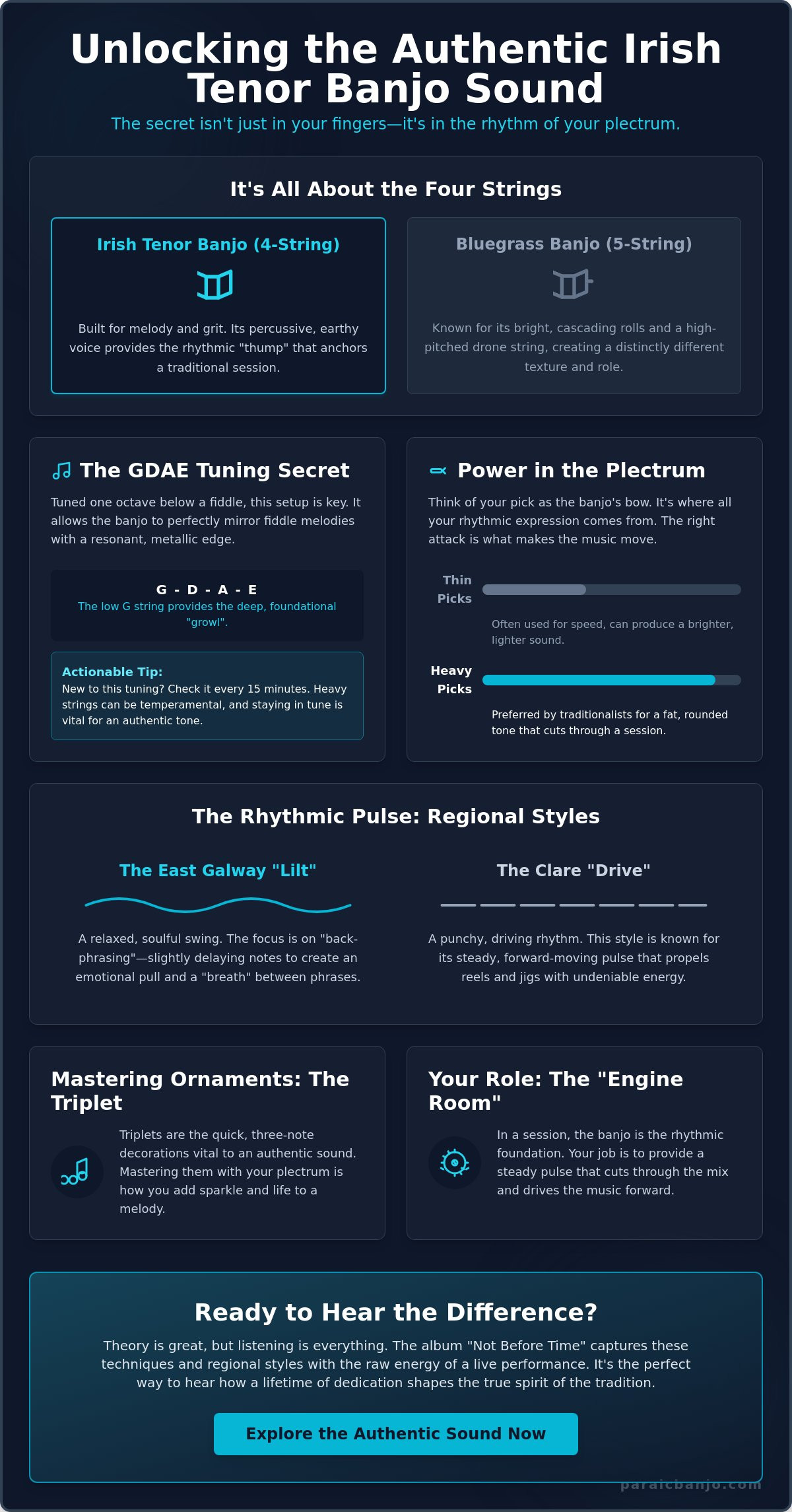
If you've ever sat in a crowded pub and felt a rhythmic pulse vibrating through the floorboards, you've likely felt the heartbeat of the tenor banjo. It's a unique beast. Unlike its bluegrass cousin with its five strings and bright, cascading rolls, the Irish variety is a four-stringed engine built for melody and grit. It doesn't just ring; it speaks with an earthy, percussive voice that stays low to the ground. This specific irish tenor banjo sound is defined by a thick, woody "thump" that anchors a session, providing a foundation that's as much about the silence between the notes as the notes themselves.
Many traditional players gravitate toward short-scale banjos, typically featuring 17 frets rather than the standard 19. These instruments offer a punchier, tighter response because the strings are under slightly more tension for their length. It's that immediate "pop" when the pick hits the string that makes the music move. You can hear this raw energy captured perfectly on the Not Before Time digital album, where the instrument isn't buried in studio polish but allowed to breathe and growl as it does in a live setting. If you want to understand the soul of this instrument, you have to appreciate its role as a rhythmic driver.
Tuning and Pitch: The GDAE Difference
The magic of the Irish style lies in the tuning. We tune our banjos to GDAE, which is exactly one octave below a fiddle. This isn't just a technical choice; it's a functional one. It allows the banjo to mirror fiddle melodies perfectly, doubling the tunes with a resonant, metallic edge. The low G string is the secret weapon here. It provides a deep, harmonic "growl" that acts as the instrument's foundation. To keep your playing authentic, you'll want to ensure your setup supports this low-end clarity. Actionable tip: If you're just starting, check your tuning every fifteen minutes. The heavy strings required for GDAE tuning can be temperamental, and staying crisp is the only way to maintain that authentic Irish tone.
The Role of the Plectrum Attack
Think of the plectrum, or the small pick, as the "bow" of the banjo. It's responsible for every ounce of rhythmic expression you produce. The thickness of your pick drastically changes the "brightness" or "warmth" of your music. While some prefer thin picks for speed, most traditionalists use heavier plectrums to get a fat, rounded tone that cuts through the sound of flutes and fiddles. Plectrum attack is the primary driver of Irish banjo dynamics. It's about more than just hitting the string; it's about the speed and angle of the strike. If you're looking for inspiration, grab a copy of the Not Before Time physical CD to hear how decades of technique translate into a plectrum attack that feels like a conversation.
The Rhythmic Pulse: East Galway vs. Clare Styles
The music isn't a monolith. While the physical instrument stays the same, the irish tenor banjo sound shifts dramatically as you travel across the island. Regional roots are the invisible threads that pull a performance together, giving it a specific flavor that locals can identify in just a few bars. If you want to dive deeper into these roots, exploring Irish banjo history and players reveals how these distinct styles evolved in dance halls and kitchens alike. Understanding these nuances is the key to moving from just playing notes to truly making the banjo sing.
Páraic Mac Donnchadha’s playing serves as a masterclass in blending these traditional rhythmic influences. His debut album, Not Before Time, represents 39 years of absorbing these regional pulses and turning them into a definitive statement. It's a lifetime of listening distilled into 18 tracks. Whether you prefer the steady drive of a Clare reel or the rolling lilt of a Galway jig, you can explore individual digital tracks to hear how these traditions come together in a way that feels both historic and fresh.
The East Galway "Lilt"
East Galway style is legendary for its relaxed, soulful feel. It's often described as having a "lilt," which is a rhythmic swing that feels more like a natural heartbeat than a mechanical metronome. In this region, speed is rarely the goal. Instead, players focus on "back-phrasing." This is where a player slightly delays a note to create an emotional pull, making the melody feel like it's leaning back into a comfortable chair. Actionable tip: When listening to traditional recordings, try to find the "breath" between the notes. This tiny pocket of silence is where the soul of the East Galway sound lives. If you're curious about the technical breakdown, you can read more in this guide on east galway vs clare music.
Clare Style and the Driving Lift
Just across the border in County Clare, the energy shifts toward the dance floor. Here, the focus is on "lift." Lift is a slight accent on the off-beat that creates a sense of forward motion. It's the musical equivalent of a gentle nudge that makes you want to tap your feet immediately. While East Galway is smooth and flowing, Clare style often has a bit more "bite" in the ornamentation. These two styles often coexist in modern sessions, creating a beautiful tension between the relaxed and the driving. This contrast is exactly what makes a live session feel so alive; it's a conversation between different ways of feeling the beat.
Mastering the Attack: Plectrum Technique and Ornamentation
The soul of the irish tenor banjo sound doesn't just sit in the notes; it lives in the tiny flourishes you weave between them. It is about the attack. It is about the spirit. While your left hand finds the melody, your right hand provides the personality. Think of your plectrum as a rhythmic brush. By varying the volume and intensity of your strikes, you move away from a mechanical, computer-like performance and toward something that feels deeply human. To truly capture that "soulful" quality, you must learn to decorate the music without cluttering it.
We use percussive textures like trebles and "cuts" to mimic the ornamentation of a piper. A "cut" is a quick, sharp strike that breaks a single note into two rhythmic pulses, adding a bite that helps the banjo cut through a noisy session. These techniques transform the banjo from a simple melody instrument into a rhythmic powerhouse. If you want to hear how these ornaments sound when they are allowed to breathe, you can purchase individual digital tracks from the Not Before Time collection. Listening to a master use these tools is the quickest way to understand their purpose.
The Art of the Triplet
Triplets are the signature decoration of the Irish banjo. A triplet is three quick notes played in the space of a single beat. The mechanics are simple but require a relaxed wrist: it's a down-up-down stroke executed with a flicking motion. There is a massive difference between a "mushy" triplet, where the notes blur together, and a "crisp" one, where each strike is distinct and sharp. Actionable tip: Don't try to play them in a tune right away. Practice your triplets slowly on a single open string. Focus on the "click" of the pick and ensure your wrist stays loose. Once the rhythm feels like a natural reflex, you can start weaving them into your favorite reels.
Left-Hand Ornamentation: Slides and Hammer-ons
While the right hand drives the rhythm, the left hand adds the "vocal" quality. "Sliding" into a note involves fret-hopping from a lower pitch up to your target note. This creates a bluesy, expressive sound that mirrors the way a traditional singer might approach a melody. Hammer-ons are another essential tool. By striking a string and then quickly "hammering" a finger onto a higher fret, you create a legato, or smooth, connection between notes. This softens the attack and makes the banjo sound less like a machine and more like a voice. These techniques are what separate a technical player from a traditional one. They provide the "lift" and the "lilt" that we discussed earlier, ensuring your music feels alive and storied.
Session Dynamics: The Banjo in the Engine Room
In the heat of a crowded session, the banjo takes on a role that is both powerful and humble. We often call it the "engine room." While the fiddles and flutes carry the soaring highs, the banjo provides the mechanical heart that keeps the whole group moving forward. It is a dual responsibility. You are responsible for the intricate melody, but you are also a rhythmic anchor. This balance is what creates a truly authentic irish tenor banjo sound. It isn't about being the loudest person in the room; it's about being the most reliable pulse in the circle.
A great player knows that listening is just as important as striking the strings. You have to respond to the lift of the fiddle and the breath of the flute. This conversational energy is why live recordings often feel so much more "real" than sterile studio tracks. When you hear the tracks on the Not Before Time album, you're hearing that raw, unpolished spirit of a live session. If you want to dive into more examples of this energy, you can check out this guide to a traditional irish session music cd to see how the banjo fits into the wider tradition.
Cutting Through the Mix
The banjo has a naturally percussive tone that is designed to "cut." In a room full of ten or twenty musicians, your notes need to have a sharp enough edge to be heard without being so abrasive that they drown out the sweetness of the other instruments. It is a delicate dance between volume and tone. Your plectrum attack, which we discussed earlier, is your primary tool for finding this balance. Actionable tip: When you're sitting into a session, try to position yourself where you can clearly hear the "pulse" of the guitar or bouzouki. If you can lock in with the rhythm players, your melody will naturally sit better in the overall mix.
Playing with Soul and Restraint
There is a common trap in banjo playing: the urge to play as many notes as possible as fast as you can. But a soulful sound often comes from what you leave out. We call this "the gap." Knowing when not to play allows the melody to breathe and gives the music a sense of space. Playing fewer notes with more "feeling" almost always sounds better than high-speed shredding that lacks a rhythmic heart. It's about respect for the tune and your fellow players. If you want to hear how this restraint sounds in practice, you can explore the full digital album and listen for the moments where the rhythm truly takes flight.
Experience the Authentic Sound with "Not Before Time"
After nearly four decades of honing his craft in the kitchens and pubs of the West of Ireland, Páraic Mac Donnchadha has released a debut that is much more than just a collection of tunes. It is a definitive statement of a lifetime's passion. Not Before Time – 39 Years in the Making was recorded live to ensure every ounce of that raw irish tenor banjo sound was preserved for the listener. There are no sterile studio tricks here. You are hearing the honest, percussive thump of the strings and the natural resonance of a master at work. If you've been searching for a recording that captures the true spirit of a live session, this work is the answer you've been waiting for.
18 Tracks of Pure Tradition
The album features 18 tracks that serve as a bridge between the East Galway and Clare styles we've explored. You'll hear a variety of reels and jigs that showcase the plectrum techniques and triplets essential to the tradition. It isn't a solitary effort; it's a spirited conversation between Páraic and a cast of featured performers who share his deep roots. Every track feels like an invitation into a storied musical tradition. Actionable tip: To get the most out of your listening, follow along with the detailed liner notes provided with the album. They offer the "story" behind each tune and help you identify the specific regional nuances as they happen. You can order the digital album to start exploring these stories immediately and deepen your connection to the music.
Why Physical CDs Offer the Best Sound
While streaming is convenient for a quick listen, many purists still prefer the uncompressed audio quality of a physical CD. Digital files on streaming platforms often lose the subtle "growl" of the low G string and the crispness of the plectrum attack that defines this instrument. This album is a piece of musical history, a limited edition record of a storied tradition that has been 39 years in the making. Owning the physical copy ensures you hear the music exactly as it was intended to be heard, with all the warmth and depth of a live performance. There is a palpable sense of celebration and relief in these tracks, making the experience feel deeply personal. You can bring the authentic sound of the West of Ireland home with the "Not Before Time" album today. It is a chance to own a definitive piece of the craft and support the continuation of this vibrant tradition.
Your Journey into the Heart of the Tradition
Mastering the irish tenor banjo sound is about more than just hitting the right frets. It is a lifelong conversation between your plectrum and the rhythmic pulses of places like East Galway and Clare. By focusing on a crisp attack and respecting the "gap" in a live session, you move closer to the soulful, earthy tone that has defined this instrument for generations. Every triplet you practice and every regional lilt you identify brings you one step deeper into this storied musical world.
If you're ready to immerse yourself in the real thing, you can order the "Not Before Time" CD and experience the authentic Irish banjo sound for yourself. This project was 39 years in the making and features 18 tracks recorded live to capture the raw energy of a traditional session. It also includes detailed historical liner notes to help you understand the heritage behind every note. It is a definitive statement of a lifetime's passion, and I'd love for you to be a part of it. Keep practicing, keep listening, and I'll see you at the next session.
Frequently Asked Questions
Is the Irish tenor banjo sound different from a 5-string banjo?
Yes, the Irish tenor banjo is a four-string instrument that serves a completely different musical role than the 5-string variety. While the 5-string banjo is famous for the rolling fingerstyle of bluegrass, the tenor is built for melody and rhythm. We play it with a plectrum to create a percussive, earthy pulse that mirrors the fiddle. It's about the "pop" of the strike rather than the ringing drone of a fifth string.
What is the best tuning for a traditional Irish tenor banjo sound?
GDAE is the standard tuning for achieving an authentic irish tenor banjo sound. This tuning is exactly one octave below a fiddle, which allows you to play the same fingerings as a violinist or mandolinist. It provides a deep, woody growl on the low strings that gives the instrument its characteristic "thump" in a session engine room. If you're coming from a different background, switching to GDAE is the first step toward a traditional tone.
How do I make my banjo sound more "soulful" and less "metallic"?
To lose that harsh metallic edge, you should experiment with a thicker plectrum and heavier gauge strings. A thin pick often creates a tinny "clack" that can be distracting. A heavy pick, usually 1.0mm or thicker, helps round off the notes and provides a warmer resonance. Focus on keeping your wrist relaxed; a stiff arm leads to a mechanical sound, while a loose wrist allows the soul of the tune to come through.
Why is the East Galway style so important to the banjo sound?
East Galway style is the bedrock of the "lilt," a rhythmic swing that makes the music feel alive. It prioritizes the phrasing and "breath" of the tune over sheer technical speed. By studying this regional approach, you learn how to lean into the notes and create a pulse that feels like a natural heartbeat. It's a style that values the emotional weight of the melody, which is essential for any player wanting to move beyond a "robotic" performance.
Can I get a high-quality Irish banjo sound from a beginner instrument?
You can certainly achieve a respectable tone on a beginner instrument if you focus on your setup. High-quality strings and a well-positioned bridge can make a massive difference in how a budget banjo responds to your touch. While a professional instrument offers more depth and volume, your plectrum technique is the most important factor. Start with what you have, focus on your rhythm, and the music will follow.
What is a plectrum, and how does it affect the sound?
A plectrum is simply a small pick used to strike the strings, and it acts as the "bow" of your banjo. The material and thickness of the plectrum change everything about your tone. A stiff pick provides a punchy, defined attack that cuts through a noisy room, while a softer pick might feel faster but often lacks the "bite" required for traditional reels. It is your primary tool for expression and dynamic control.
How many frets should an Irish tenor banjo have for the best sound?
Many traditional players prefer a 17-fret short-scale banjo for its punchier, tighter response. Because the neck is shorter, the strings are under a specific tension that creates a very immediate "pop" when struck. While a 19-fret model is common and offers more range, the 17-fret version is often favored in sessions because its percussive nature helps the player act as the rhythmic anchor for the group.
Where can I hear authentic rhythmic Irish tenor banjo playing?
The best way to hear the instrument correctly is through live, unpolished recordings that haven't been over-produced. Páraic Mac Donnchadha’s debut album, Not Before Time, features 18 tracks recorded live to capture the true irish tenor banjo sound. It's a definitive resource that showcases 39 years of rhythmic mastery. Listening to these tracks will help you identify the "lift" and "lilt" we've discussed throughout this guide. Enjoy the tunes!


Comments