Traditional Irish Instrumental Albums: Duration and Track Lists

A traditional Irish instrumental album has no set running time: its length depends on the number of tracks and how the tunes are arranged. Some recordings move briskly through short sets, while others give each melody more room to breathe. The track listing is the clearest guide to what you’ll hear and how the album unfolds.
That variety is part of the pleasure. A familiar reel can feel lively and direct in one arrangement, then take on a different character as musicians shape its rhythm, phrasing, and pace.
Here, you’ll learn what affects an album’s duration, how to read a track listing, and which traditional recordings and tunes are worth exploring. We’ll also look at notable arrangements and the details that help you choose an album to suit your mood, whether you want a spirited session sound or music to settle into. Let’s get into the tunes.
Table of Contents
Album duration
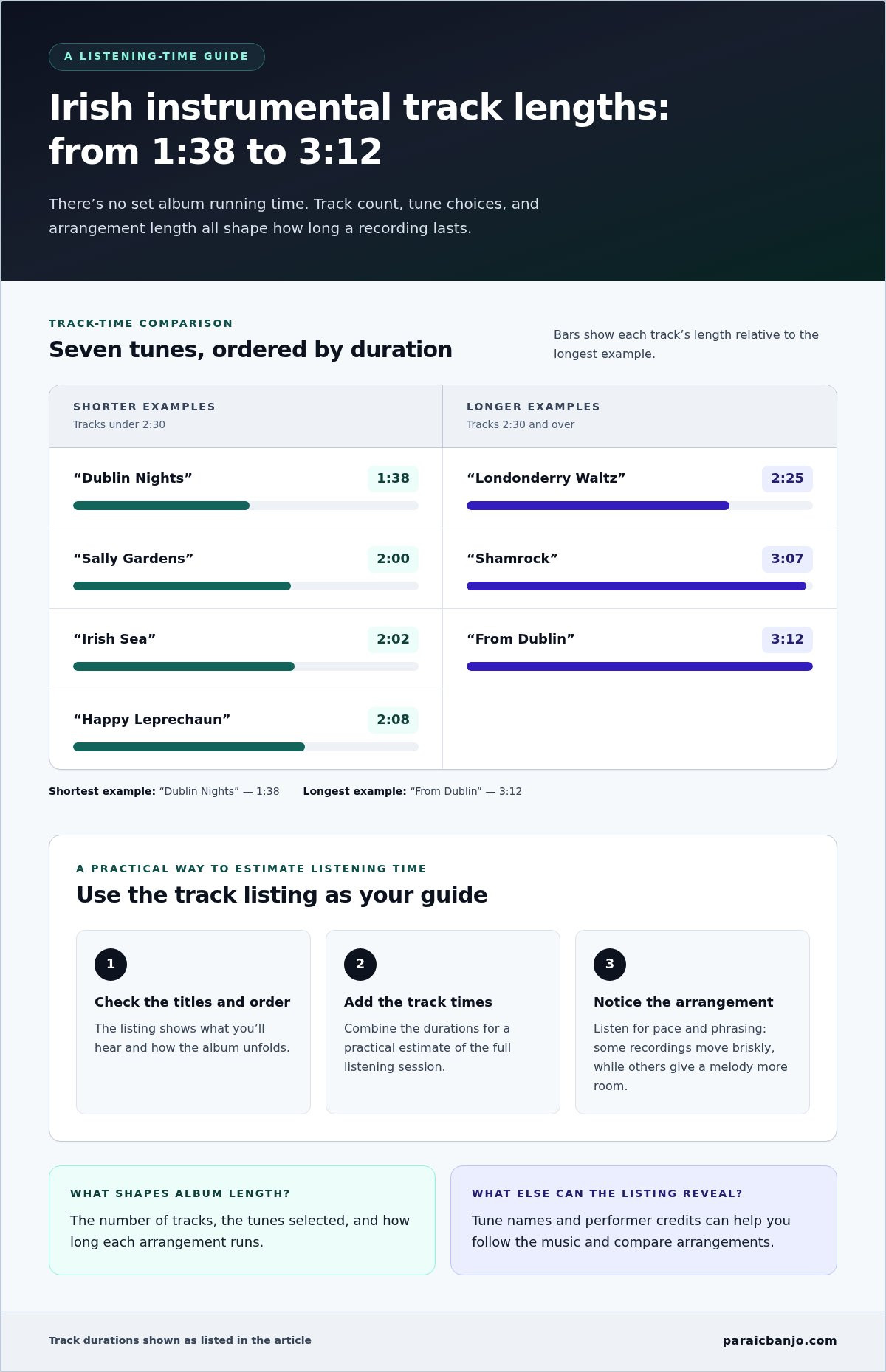
A traditional Irish instrumental album has no fixed running time. Its length depends on track count, tune choices, and arrangement length. Add the durations in the track listing to estimate listening time. “Sally Gardens” lasts 2:00 minutes, “From Dublin” runs 3:12, and “Happy Leprechaun” lasts 2:08. These examples show how a short tune can sit beside a longer performance. Use the listing for a practical estimate before you choose a recording.
What are good traditional Irish instrumental albums for beginners? Start with a clear track listing and performer credits. These details help new listeners connect tune names with musicians and hear how arrangements differ. Choose a traditional Irish instrumental album with titles you can follow, then listen for the instrument carrying the melody.
How do solo, session, and ensemble recordings differ? A solo recording focuses on one musician’s phrasing. A session captures musicians playing together, while an ensemble recording presents a group arrangement. Listen for the lead melody and how the other players support it.
What affects the cost of these albums? Format and seller affect the price. Compare digital and physical options for the recording you want. Individual tracks may suit listeners seeking particular tunes rather than a complete album.
Which instruments commonly appear on Irish music recordings? Listen for fiddle, flute, tin whistle, uilleann pipes, accordion, concertina, or banjo. Guitar and bouzouki can provide rhythmic accompaniment. Try identifying the melody instrument first, then listen again for the supporting parts.
Which artists and groups are influential? Seán Ó Riada and Ceoltóirí Chualann are important names to explore. Ceoltóirí Chualann originally came together in 1960. The Chieftains formed in 1962, offering another starting point for hearing Irish group arrangements.
Where can I stream or buy Irish instrumental recordings? Streaming services offer listening access, while digital albums and physical CDs are purchase formats. Read the track listing first to see whether it offers a full programme or particular tunes. You can also explore a traditional Irish instrumental album one track at a time.
Which recent releases have earned acclaim? Consider the release date, critical reception, performers, and instrumentation together. These details help distinguish a recent release from an established recording and give you a sense of its sound. Compare the arrangement style with music you already enjoy.
Track times also reveal how a sequence may feel. “Dublin Nights” lasts 1:38, while “Shamrock” runs 3:07. “Irish Sea” is 2:02, and “Londonderry Waltz” is 2:25. Add the durations to estimate the full listening session. Then notice whether the arrangement gives each tune room to develop or moves briskly between melodies. That’s a useful way to choose a traditional Irish instrumental album for a short listen or a longer stretch with the music.
Notable tunes and album arrangements
A tune’s character comes through in more than its melody. Listen for the lead instrument, the supporting rhythm, and changes in pace. “Galway,” “Irish Luck,” and “Tawnyard” are useful track-title examples when comparing listings. Note the performers beside each title, then listen for how each player shapes the tune.
Changes in arrangement can make familiar melodies feel distinct. A solo performance keeps the focus on one player’s phrasing, while a group arrangement adds musical conversation. Listen for a melody passed between instruments, a steady accompaniment, or a shift in texture. These details show how musicians build momentum without changing the tune itself.
Which traditional Irish instrumental albums feature fiddle, flute, harp, or uilleann pipes? Check the performer credits and instrument notes for each album, since titles alone don’t identify its sound. Look for fiddle, flute, harp, or uilleann pipes in the credits, then sample a track to hear how the instrument leads or supports the arrangement.
Track order also shapes an album’s journey. A lively opening can set an energetic tone, while a slower selection can create contrast later. Compare the opening track titles with the closing selections, and notice whether the sequence alternates between moods. This simple listening step helps you understand the album as a complete programme.
For a focused comparison, choose two recordings that include the same tune. Start with the melody, then listen again for ornamentation, accompaniment, and transitions. Ornamentation means small decorative notes added around the melody. Differences can come from a musician’s phrasing, the instruments playing together, or the way one tune leads into another.
Group names offer another useful route into the tradition. Ceoltóirí Chualann and The Chieftains are notable ensembles to explore. Compare how their group performances balance melody and rhythmic backing. Notice whether the musicians stay in close unison or create a fuller texture, with separate parts supporting the lead.
Use a short listening checklist for each recording: identify the lead instrument, note the accompaniment, and mark any change in pace. Then compare what you hear in “Galway” and “Irish Luck.” The titles give you specific tracks to revisit, while repeated listening helps you hear how musical choices shape the arrangement.
Keep the album’s purpose in mind as you choose. A solo-led recording brings one player’s style into focus; a larger group can offer interplay and varied textures. Use the performer credits and a sample track to find the sound you want. Then listen through the full sequence and let the arrangements unfold.
Track listing
A track listing is a map of an album’s musical programme. It shows titles and sequence, helping you follow changes in tune, mood, and arrangement. Use it alongside the performer credits: a title identifies a selection, while the credits tell you who plays it. For example, “Tawnyard” is a useful search term when locating a specific recording in a collection.
Start by reading titles in order rather than scanning only for familiar names. A sequence can move between reels, jigs, hornpipes, and slower airs, though titles alone don’t always identify a tune type. Treat each name as a listening prompt. When a title catches your eye, note its position, then listen for how the surrounding selections shape its place in the programme.
A useful track-listing check has three parts:
Read the title. Notice whether it names a place, person, or tune, as “Galway” does.
Check the sequence. Compare the opening, middle, and closing selections instead of judging one track alone.
Match credits to tunes. Look for performer names beside individual tracks or in the album notes.
That last step matters when a traditional irish instrumental album features several musicians. A group credit may identify performers collectively, while track-level notes can connect a player to a particular selection. If the listing gives only titles, use the accompanying notes as a guide. Record each tune name alongside its performer to make a clearer reference for later listening.
Track titles may also describe tune sets. A set joins melodies into one continuous performance, so a single listing entry can represent more than one tune. Look for multiple names joined by punctuation or wording such as “medley.” Then listen for the transition between melodies. This helps distinguish a single tune from several tunes presented as one track.
For collecting, keep a simple catalogue with the album title, track title, performer credit, and format. Preserve the spelling shown on the release, especially for Irish place names and tune names. If two listings use different spellings, note both rather than assuming they refer to separate melodies. Your notes will make it easier to find a recording again.
Finally, compare listings by what they reveal, not just by familiar titles. “Sally Gardens” may catch your attention, but performer details, set structure, and sequence offer more context. Use those clues to choose a track for focused listening, then return to the full programme. A well-read listing turns casual browsing into a more deliberate listening plan.
Runtime offers another way to compare selections without treating it as a measure of quality. “Irish Luck” is 2:55 long, “Galway” is 2:13 long, and “Tawnyard” is 2:27 long. Keep these lengths beside the sequence and credits when choosing what to hear first. A shorter or longer selection may suit a particular listening session, while the track’s position and performer information still help explain its role in the programme. As Páraic Banjo often notes, use the listing as a practical guide, then let the recording supply the musical detail.
What are the best traditional Irish instrumental albums?
There’s no single ranking that suits every listener. A useful starting point is Ó Riada sa Gaiety, recorded in 1969. Treat it as a historical reference, then decide what you want from your listening: a strong melody, lively rhythmic drive, or the sound of musicians playing together. Your own priorities make “best” a more practical choice than a universal list.
For another point of comparison, explore recordings connected with Seán Ó Riada, Ceoltóirí Chualann, and The Chieftains. Focus on one quality at a time. For instance, listen for how the lead tune is supported, or whether the arrangement feels tightly unified or more conversational. This makes it easier to compare performers without reducing their styles to a simple ranking.
A traditional Irish instrumental album may become a favourite because of one tune, a performer’s phrasing, or the shape of its full programme. Before choosing, scan the titles and credits. Pick one track that interests you, then listen for the musical detail that holds your attention. Return to the complete recording afterward and see how that track fits the album.
Use these questions to build a shortlist:
Which sound draws you in? Choose a lead instrument or group texture you enjoy.
What do the credits reveal? Note the musicians and ensemble name beside the recording.
How does the programme flow? Consider the order of tracks and changes in mood.
Would you replay it? Keep titles that invite another listen, not just a first impression.
Collectors can add context to those listening notes. Record the album title, performer names, track that stood out, and the reason it appealed. For Ó Riada sa Gaiety, the 1969 recording date gives a firm historical detail to preserve. The same method helps distinguish recordings in a growing collection and makes later comparisons more meaningful.
Try comparing two recordings with the same listening focus. Follow the melody in each, for example, or notice how the accompaniment shapes the pulse. Write a brief note after each listen. A traditional Irish instrumental album that suits your taste will give you details to revisit, whether it’s a tune, a player’s touch, or the way the ensemble moves together.
Let curiosity guide your next choice. Begin with a familiar name, follow a track title that catches your eye, and keep the recording that rewards another listen. That’s a straightforward way to find albums you’ll want to return to.
Which traditional Irish instrumental albums are considered classics?
Classic status isn’t just about age or reputation. For a collector, it can also come from a recording’s musical character, the way it preserves a particular performance, or its lasting place in personal listening. Ask yourself what brings you back to an album: the lift of a dance tune, the musicians’ interplay, or the feeling of hearing a tradition carried forward.
Think of an album as a record of musicians making choices together. A performance captures a particular balance, tempo, and exchange between players. Those details give a recording its own character, even when other musicians play familiar material. Listen for the moments that feel distinctive, then decide whether the album earns a lasting place in your collection.
Collectors can also consider how a recording supports their wider exploration of Irish music. An album may introduce an instrument, a playing style, or a set of tunes that leads you to new listening. Keep a brief note about what it opened up for you. That personal connection can be as meaningful as a broad historical reputation.
Use these prompts to assess a potential classic:
Does it hold your attention? Notice whether the performance invites a complete listen.
Can you hear the musicians’ character? Focus on their phrasing and the way they play together.
Does it lead you somewhere new? Record any tune, instrument, or style you want to explore further.
Will you return to it? A recording that rewards repeated listening may become a personal cornerstone.
There’s no need to settle the question with a universal ranking. Build your own sense of what matters by listening with curiosity, then revisiting recordings after a break. A detail you missed on the first play may become the reason an album stays with you.
Keep your collection connected to the music itself. Instead of focusing only on a title’s reputation, give each recording a patient listen and trust your response. If you’d like a contrasting sound, you can explore a live Irish instrumental recording and hear how musicians shape a performance together.
Páraic Banjo: Not Before Time - 39 Years in the Making (Physical CD)
Not Before Time - 39 Years in the Making brings traditional Irish session music together across 18 tracks recorded live with expert musicians. Turn to it when you want a complete album of banjo-led instrumental music, shaped by the interplay of a group rather than a solo performance. The live recording gives the tunes a shared, session-style feel.
Choose the physical CD for a tangible addition to your collection, the digital album for a full-album download, or individual digital tracks to select particular tunes. Each option offers a different way to spend time with the same musical project.
Visit Páraic Banjo online to explore Not Before Time - 39 Years in the Making.
Let the next tune lead you
Make your next listen an active one. Choose a traditional Irish instrumental album, settle on one musical detail to follow, and notice how your attention shifts. You might track the melody through a set, listen for the rhythmic lift underneath, or focus on how the players respond to one another. A few notes afterward can help you remember what moved you and guide your next musical discovery.
There’s no need to build a collection all at once. Follow the performers and sounds that stay with you, then explore at your own pace. If you’d like to continue with Páraic Banjo’s music, visit Páraic Banjo’s website. Keep listening, keep exploring, and enjoy the journey.
Frequently Asked Questions
How much do traditional Irish instrumental albums cost?
Format and seller affect the price. Compare digital and physical options for the recording you want.
Which traditional Irish instrumental albums feature fiddle, flute, harp, or uilleann pipes?
Check each album’s performer credits and instrument notes for fiddle, flute, harp, or uilleann pipes, then sample a track to hear the instrument in the arrangement.
Comments