What is Session Music? A Beginner’s Guide to the Heart of Irish Tradition

Updated: Sep 1
Imagine walking into a snug pub in East Galway and finding a corner packed with fiddles, flutes, and banjos. There are no sheet music stands and no stage lights, just a group of people lost in the pulse of a driving reel. You might find yourself asking, what is session music exactly? Is it a professional studio job, or is it just a social night out? It is actually both, and that dual nature is exactly what makes it the beating heart of Irish tradition.
It is perfectly normal to feel a bit intimidated by the unwritten rules of a "sessiún." You don't want to step on toes or break the flow of the music. We have spent nearly forty years immersed in this world, and we are here to help you understand the difference between technical studio work and the magic of a live pub circle. You will discover how to behave at a session, what terms like "sean-nós" really mean, and how to find high-quality recordings that capture that raw, live energy. Whether you are a curious listener or a budding player, this guide will give you the keys to the tradition. Let's explore the rhythm and soul of this storied musical heritage together.
Table of Contents
The Two Faces of Session Music: Studio vs. Tradition
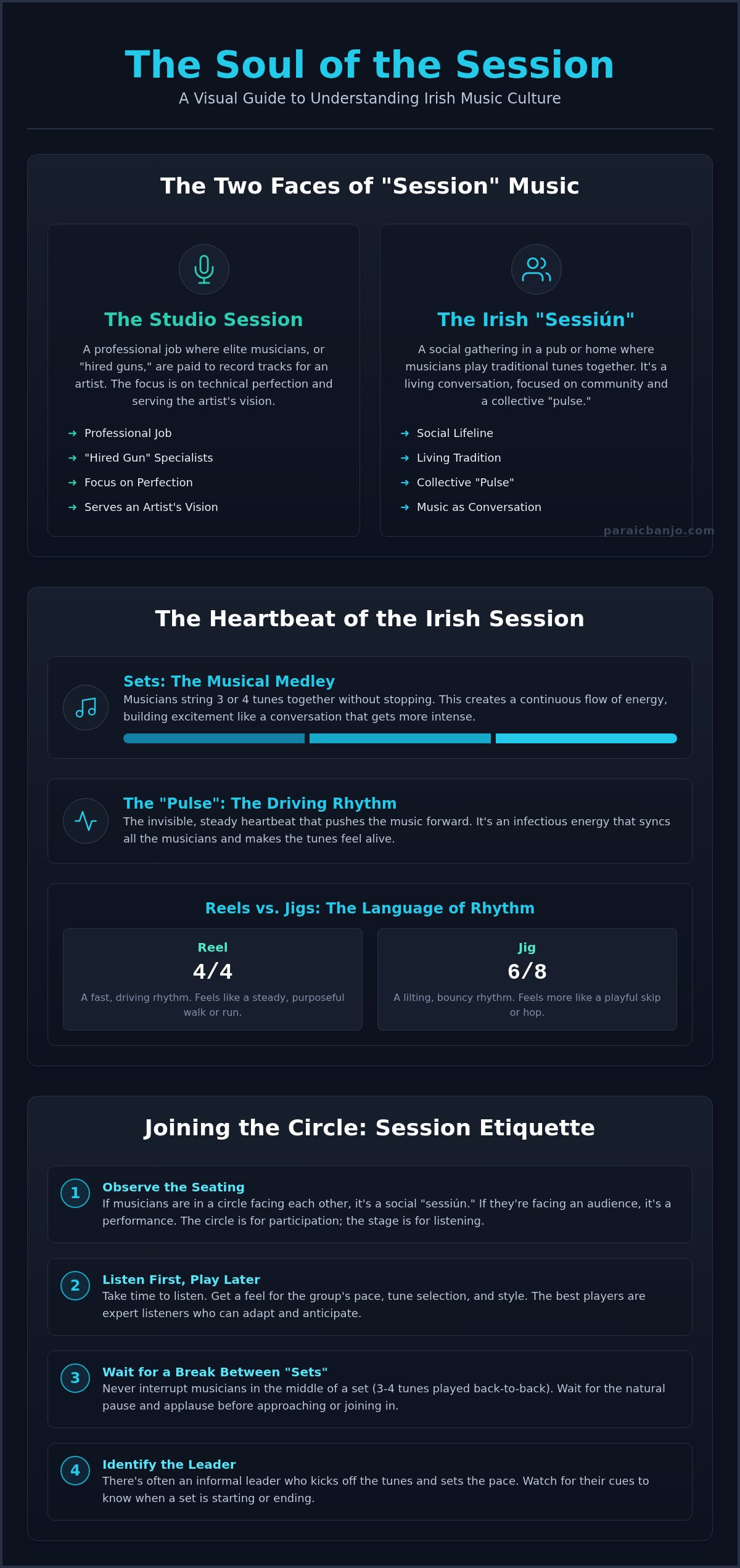
The term "session" wears two very different hats depending on who you ask. If you are in a recording studio in London or Nashville, a session is a professional job. But if you are in a pub in County Clare, it is a social lifeline. To truly understand what is session music, you have to look at both the polished studio work and the raw, rhythmic energy of the traditional Irish "sessiún." While they seem worlds apart, they both rely on a musician's ability to listen, adapt, and play with absolute precision.
The common thread between these two worlds is the "ear." Whether you are in a soundproof booth or a crowded bar, you must be an expert listener. You have to anticipate the next turn in a melody or the subtle shift in a rhythm. It is a high-level skill that takes years to master. If you want to hear this balance for yourself, you can explore the tracks on my debut album, Not Before Time – 39 Years in the Making, which was recorded live to bridge the gap between studio clarity and authentic session soul.
The Hired Gun: What is a Studio Session?
In the professional music industry, a session musician is often called a "hired gun." These are elite players brought in to help a solo artist or a band finish a record. They aren't permanent members of the group; they are specialists. You might see a pop band hire a banjo player to add a specific folk texture to a single track. Legendary backing groups like The Wrecking Crew in the 1960s played on thousands of hits without ever being the "face" of the band. It is about being a versatile sideman who can walk into a room and nail a perfect take on the first try. Their job is to serve the artist's vision with technical perfection.
The Living Tradition: What is an Irish Music Session?
Step into an Irish "sessiún" and the vibe changes completely. Here, the music isn't a job; it is a conversation. A traditional session is a social gathering where musicians meet to play tunes they all know by heart. There is no stage and no ticket price. The pub serves as the community's concert hall. In this world, the music belongs to everyone. It is about the collective "pulse" rather than individual stardom. You play for the person sitting next to you as much as for the crowd. It is a living, breathing tradition that has been passed down through generations in kitchens and corners across Ireland.
Actionable Tip: If you are ever unsure which type of session you are attending, look at the seating. If the musicians are in a circle facing each other, it is likely a traditional sessiún. If they are facing an audience or behind a glass window, it is a professional studio gig. Always wait for a break between sets of tunes before approaching the musicians to ask about the music.
The Heartbeat of the Irish Session: Reels, Jigs, and the Pulse
If you've ever sat in a pub and felt the energy in the room shift as a new tune starts, you've felt the heartbeat of the tradition. When people ask what is session music, they are often asking about that invisible force that keeps everyone in sync. It isn't just about playing a single melody. It is about the "set," where musicians string three or four tunes together without stopping. This transition keeps the energy climbing. It is like a conversation that gets more exciting as it goes on. Each tune in the set adds a new layer of emotion and drive.
The "Pulse" is what makes this happen. It is a steady, driving rhythm that pushes the music forward. Without it, the tunes are just notes on a page. With it, they become something you can feel in your chest. It is an infectious sort of magic. If you want to hear this drive in action, you can listen to Not Before Time – 39 Years in the Making, where we captured that live, breathing energy in every track. It is like having a session right in your living room.
Reels and Jigs: The Language of the Session
Every session relies on two main building blocks: the reel and the jig. A reel is a driving 4/4 rhythm. Think of it as the steady, walking heartbeat of the night. It is fast, rhythmic, and perfect for a high-energy dance. On the other hand, a jig has a 6/8 lilt. It feels more like a skip or a bounce. If the reel is a steady run, the jig is a playful hop. These two rhythms provide the foundation for everything we do. Once you can tell them apart, you will start to hear the intricate patterns that define what is session music at its core.
Regional Styles: From East Galway to Clare
The feel of a session often depends on where you are in Ireland. The East Galway vs Clare music styles offer a perfect example of this variety. East Galway music is often known for being slightly more relaxed and melodic. It has a beautiful, rolling quality that lets the tunes breathe. Clare music often has a bit more "swing" or lift. It is punchy and rhythmic, designed to get people moving.
The tenor banjo plays a massive role in these traditions. It provides the rhythmic backbone that holds the fiddle and flute together. In these regional styles, the banjo isn't just a melody instrument; it is the engine. Purists often listen for these subtle differences in tempo and attack because they tell the story of the specific community the music comes from. It is a badge of identity for the players.
Actionable Tip: To get the most out of listening to a session, try to spot the moment a set "turns." This is when the musicians finish one tune and immediately start the next. Watch the lead player; they will often give a small nod or a lift of the instrument to signal the change. Learning to anticipate this shift will help you feel the music like a local instead of just a tourist.
Joining the Circle: 5 Actionable Tips for Session Etiquette
Walking into a pub where the music is already in full swing can feel like crashing a private party. But don't let that stop you. The "unwritten rules" of the pub are really just about respect and listening. To truly grasp what is session music, you have to realize it's a shared space. It isn't a stage performance for an audience; it's a social conversation between the players. If you approach it with a bit of humility, you'll be welcomed with open arms.
First, always listen before you join. Every session has a unique "vibe" or speed. Some are fast and fiery, while others are slow and melodic. If you just jump in without feeling the room, you might disrupt a rhythm that took an hour to build. Second, find the "Lead" musician. This is usually the person who starts the sets. They decide the tempo and which tune comes next. Follow their lead to keep the collective pulse steady.
Third, stick to the staples. The tenor banjo is a session favorite because its bright, percussive tone helps define the rhythm without drowning out the fiddles. Fourth, watch your volume. The "Golden Rule" is to play for the circle, not the back of the room. You should be able to hear the person sitting three chairs away from you. Finally, if you don't know a particular tune, it's perfectly fine to sit one out. It's better to listen than to play the wrong notes.
For the Aspiring Musician
If you want to sit in, make sure you have a solid repertoire. Aim to have at least 20 common reels and jigs under your belt before you pull up a chair. Most sessions happen in the keys of D or G, so focus your practice there. If the music moves into a tune you don't recognize, put the instrument down and enjoy the "craic." That's the Irish word for the fun, social atmosphere and good conversation that happens between the sets. Being a good listener is just as important as being a good player.
For the Enthusiastic Listener
You don't need an instrument to be part of the magic. Just be mindful of where you sit. The inner circle of chairs is usually reserved for the musicians. Find a spot just outside that ring where you can see the fingers flying. When it comes to applause, wait for the end of the full set. Musicians usually play three tunes back-to-back, so clapping in the middle can break the momentum. You can also support the tradition by learning how to buy music direct from the artist. This ensures the players can keep the tradition alive for the next generation.
Actionable Tip: If you're a musician, always ask the lead player if it's okay to join before you unpack your case. A simple "Mind if I join you for a few?" goes a long way in establishing a friendly connection with the group.
Studio Recording vs. Live Session: Capturing the Raw Energy
There's a massive difference between a track that's technically perfect and one that has a soul. In a modern studio, it's easy to record every instrument separately and polish out every tiny breath or scrape of a string. But for traditional music, that perfection often feels sterile. It misses the "lift" that happens when musicians are actually in a room together, reacting to each other's energy in real time. To truly understand what is session music in a recorded sense, you have to look for that organic, live feel where the timing isn't dictated by a computer, but by the collective heartbeat of the players.
When we set out to record Not Before Time – 39 Years in the Making, we knew we couldn't just use standard studio tricks. We needed the energy of a pub corner, but with the clarity of professional microphones. This "live-in-studio" approach is the only way to preserve the "swing" of the tunes. It allows for those tiny, spontaneous variations in tempo that make the music feel like it's breathing. If an album feels too metronomic or "flat," it's likely because the musicians weren't playing off each other's cues.
Actionable Tip: When you're shopping for recordings, check the credits for the phrase "recorded live in studio." This usually means the musicians played together in one room, which is the gold standard for capturing that authentic, driving pulse.
The Challenge of Recording Trad
Recording the tenor banjo is a particular challenge. It's a bright, percussive instrument that needs room to "breathe." If the acoustics are too tight or dry, you lose the beautiful resonance that makes the banjo sing. You also need to capture the interaction between the instruments. In a real session, the banjo, fiddle, and piano are constantly adjusting to one another. That's where the magic happens. We also believe that liner notes are essential. They preserve the history and provenance of each track, telling you who played the tune and where it came from, which is vital for keeping the tradition alive.
Finding Authenticity in a Digital World
It's easy to get lost in a sea of "Celtic-lite" playlists that use heavy synthesizers or generic, looped beats. These often lack the rhythmic soul of the west of Ireland. When you're searching for what is session music, look for recordings that feature musicians who are active in the tradition. There's a reason why purists still value a limited-edition physical CD. It offers a tactile connection to the work and includes extensive background notes that you just don't get with a digital stream. It's about owning a piece of the story.
If you're looking to build a library that reflects the true spirit of the pub, discover why collectors prefer traditional Irish session music CDs for their authenticity and depth.
Experience the Session Pulse with 'Not Before Time'
After exploring the unwritten rules and the driving rhythms of the pub, the best way to truly grasp what is session music is to simply listen. My debut album, Not Before Time – 39 Years in the Making, was created to be your front-row seat to an authentic sessiún. This isn't a collection of sterile, over-produced tracks. Instead, it is a living tribute to the energy and community we have discussed throughout this guide. It captures that elusive "lift" that happens when the music and the room become one.
It took 39 years to bring this project to the light of day. That might seem like a long time, but a tradition this deep cannot be rushed. It is a definitive statement of a lifetime spent in the corners of pubs from East Galway to Clare. With 18 tracks of reels and jigs, this album captures the raw, unadulterated "pulse" that defines what is session music at its core. Whether you are at home or on the road, you can experience that infectious energy whenever you like. We have handled the technical side so you can focus on the soul of the tunes.
Actionable Tip: When you first listen to the album, try to listen to a full set of three tunes without skipping. This will help you feel how the energy builds from the first note to the last, exactly as it would during a live night in a local snug.
A Rhythmic Journey Through Galway and Clare
The album features collaborations with expert musicians who understand the subtle "swing" of the West. You will hear the sensory, rolling style of East Galway banjo playing; a sound that is melodic and relaxed but still carries a powerful rhythmic drive. It is a perfect gift for any Irish music lover, offering a "session in a box" for those who want to hear the real thing. Each track was recorded live to ensure the interaction between the banjo, fiddle, and piano feels as organic as possible. It is about the shared joy of the craft.
Order Your Piece of Irish Heritage
You can choose how you want to bring this music into your life. We offer a high-quality digital download for instant access, or a physical CD for the true collectors. The physical album is a piece of heritage in itself, featuring extensive background notes and credits that digital streams often leave out. Buying direct from the source ensures that the preservation of these regional styles continues. It is a direct way to support the musicians who keep this culture breathing. We offer global delivery to ensure this music reaches every corner of the world.
Ready to bring the pub home? Get your copy of Not Before Time today and join us in celebrating four decades of music, rhythm, and community.
Take the Pulse of the Tradition Home
You have journeyed from the quiet focus of the professional studio to the crowded, rhythmic corners of the Irish pub. By now, you know that the heart of this tradition isn't just about playing notes; it's about the "pulse" and the community that keeps it beating. Whether you are learning your first twenty tunes or simply looking for the right spot to sit and listen, you now have the tools to respect the circle and enjoy the craic. Understanding what is session music means recognizing it as a living conversation that has survived for generations through shared sets and social bonds.
If you want to keep that energy close at hand, it's time to move from theory to the real thing. You can bring the authentic Irish session home with "Not Before Time". This debut features 18 tracks recorded live with expert musicians, capturing the celebrated East Galway and Clare banjo styles in their purest form. The album is available as a limited-edition physical CD or a digital download, serving as a definitive statement of a lifetime's passion. Pick up your copy, turn up the volume, and let the rhythm of the west carry you away. We'll see you in the corner soon!
Common Questions About Session Music
What is the difference between a session musician and a music session?
A session musician is a professional hired to play on a specific recording or for a live gig, often working as a "hired gun." In contrast, a music session is a social gathering where musicians play for pleasure and community. While the studio worker focuses on technical perfection for a client, the pub player focuses on the collective pulse and the "craic." Both require high-level skill but serve very different social purposes.
Do I need an invitation to join an Irish music session?
Most pub sessions are "open." You don't need a formal invite to sit in. However, you should always listen for a few sets first to gauge the speed and skill level. It's good etiquette to catch the eye of the lead musician and ask if they mind you joining. Some sessions are "closed" groups, so observing the room first is the best way to avoid an awkward moment.
What instruments are typically found in an Irish session?
You will usually find a core group of melodic instruments in the circle:
The fiddle, flute, and tin whistle
The tenor banjo for its driving rhythm
Uilleann pipes and accordions for rich texture
Rhythm is often provided by a guitar or a bodhrán, which is a traditional frame drum. Every instrument contributes to the pulse that makes the music feel alive and keeps the dancers moving. For percussionists who want to hone their skills outside of the pub,
provides a wide selection of backing tracks that are ideal for practicing your timing and groove.
Are session musicians paid for their work in a studio?
Yes, professional session musicians in a studio are paid for their time and expertise. This is a commercial transaction where the player helps an artist complete a project. In the traditional world, pub sessions are almost always unpaid. Musicians play for the love of the tunes and the company of their peers. It's a social tradition rather than a commercial gig, though it requires just as much dedication and skill.
What is the best way to learn tunes for a session?
The most authentic way is to learn by ear. Spend time listening to legendary players and high-quality recordings that capture the real energy of the tradition. My album, Not Before Time – 39 Years in the Making, features 18 tracks of reels and jigs that are perfect for study. By listening to the phrasing and rhythm of experienced players, you'll pick up the subtle "swing" that sheet music simply cannot teach you.
Why is it called "session" music?
The term comes from the idea of a "sitting" of musicians coming together in one place. It describes the act of gathering to share a common repertoire of tunes. Over time, the word became synonymous with the informal pub gatherings that define Irish culture. If you've ever wondered what is session music, it's really about this collective experience where the tunes are the main reason for the meeting.
Can any genre of music have a session?
To find the real rhythmic soul of the tradition, you should look for recordings made by musicians who have spent decades in the sessions. If you want to hear what is session music at its best, avoid generic background tracks. Authentic recordings like Not Before Time – 39 Years in the Making are recorded live to preserve the raw energy. You can find these direct from the artist to support the tradition.


Comments